> ## Documentation Index
> Fetch the complete documentation index at: https://calcs.com/docs/llms.txt
> Use this file to discover all available pages before exploring further.
# Understanding Gross vs Net Soil Bearing Pressure in Spread Footing Design
> How Calcs.com calculates gross and net soil bearing pressure, what the difference is, and how to input geotechnical values correctly.
### **This article explains:**
* The difference between **gross** and **net** soil bearing pressure
* Why geotechnical engineers typically provide **net allowable** bearing pressures
* How **Calcs.com** computes gross and net bearing pressures using LRFD principles
* How footing self-weight and overburden soil are incorporated into the calculations
* How to correctly input **gross** or **net** allowable bearing capacity values from a geotechnical report
***
# 1. What Is the Difference Between Gross and Net Bearing Pressure?
## 1.1 Gross Bearing Pressure (qg)
**Gross** pressure is the **total** pressure acting on the soil under the footing.
It includes:
* Load from the structure (P)
* Self-weight of the footing (SW)
* Weight of soil/backfill sitting above the footing (Wsoil)
**Formula:**
$$
q_g = \frac{P + SW + W_{soil}}{A}
$$
This is exactly what the calculator reports as **Soil Gross Bearing Stress** (qs).
## 1.2 Net Bearing Pressure (qnet)
**Net** pressure represents only the **increase in pressure** caused by the structure **after excavation**.
It removes the weight of the soil that originally filled the space where the footing now sits.
**Formula:**
$$
q_{net} = q_g - \gamma_s h_{soil}
$$
Where:
* γs = unit weight of soil
* hsoil = depth from ground surface to the footing base
The calculator reports: **Ultimate Net Bearing Pressure** (qnu).
***
# 2. Why Geotechnical Engineers Usually Give *Net* Allowable Pressure
Geotechnical field tests measure soil behavior at depth **before excavation**. Because the soil originally carried its own self-weight, engineers often subtract this "overburden" from the allowable capacity.
This is why reports often say:
> "Allowable bearing pressure: **net** of footing weight and overburden."
Meaning:
* Footing weight should **not** be counted against the allowable capacity.
* Only the **structural load increase** matters.
***
# 3. How the Calcs.com Calculator Computes Bearing Pressure
The calculator performs two distinct sets of calculations: one for checking the soil (ASD) and one for designing the concrete (LRFD).
## 3.1 The Soil Check (ASD): Calculating Gross Stress (qs)
To check if the soil will settle or fail, Calcs.com calculates the **Soil Gross Bearing Stress** (qs). This uses **Unfactored (ASD)** loads.
The calculator sums the structural loads, the footing self-weight, and the soil surcharge weight:
$$
P_{total} = P_{ASD} + SW + W_{soil}
$$
It then divides by the footing area to find the applied stress:
$$
q_s = \frac{P_{total}}{B \times L}
$$
**Where:**
* PASD = Governing unfactored service load.
* SW = Self-weight of the concrete footing (wc × B × L × H).
* Wsoil = Weight of the soil above the footing (γs × Area × hsoil).
This result (qs) is compared directly against your input for **Allowable Soil Gross Bearing Capacity** (qa).
***
## 3.2 The Concrete Design (LRFD): Calculating Net Stress (qnu)
To design the steel reinforcement and check shear strength, the calculator must determine the force trying to bend the footing upwards. This uses **Factored (LRFD)** loads.
The calculator computes the **Ultimate Net Bearing Pressure** (qnu). This pressure excludes the weight of the footing and soil because those gravity loads act downwards, canceling out the upward soil pressure they create.
**How it is calculated in the internal logic:**
1. **Calculate Ultimate Gross Pressure (qgu):**\
The calculator takes the maximum factored structural load (Pu) plus the factored weight of the footing and soil (Wuf):
$$
q_{gu} = \frac{P_u + W_{uf}}{B \times L}
$$
2. **Subtract the Weight to Find Net (qnu):**\
The calculator then subtracts the factored weight of the footing and soil:
$$
q_{nu} = q_{gu} - \frac{W_{uf}}{B \times L}
$$
**Result:**\
The Ultimate Net Pressure (qnu) is effectively just the **factored structural load (Pu) divided by the area**.\
This is the pressure used to calculate bending moments (Mu) and shear (Vu) in the concrete.
***
## 3.3 What Is Wuf?
Wuf represents the **factored** weight of:
* the concrete footing (**self-weight SW**)
* the soil above the footing (Wsoil)
Calcs.com applies the LRFD dead-load factor directly:
$$
W_{uf} = (\text{DL Factor}) \cdot (SW + W_{\text{soil}})
$$
This ensures consistency with ACI 318 LRFD load combinations.
***
# 4. How to Enter Geotechnical Values Correctly
## 4.1 If your geotechnical report gives **Gross Allowable Bearing Capacity**
Enter it directly into:
> **Allowable Soil Gross Bearing Capacity (qₐ)**
***
## 4.2 If Your Geotechnical Report Provides **Net Allowable Bearing Capacity**
When the geotechnical engineer provides a **net** allowable bearing capacity (qna), you must convert it to a **gross** allowable value before entering it into Calcs.com.
Use the conversion:
$$
q_a^{\text{gross}} = q_{na} + \gamma_s h_{\text{soil}}
$$
Where:
* qna = net allowable bearing capacity
* γs = soil unit weight
* hsoil = depth from ground surface to the footing base
### Example Calculation
* Net allowable = **1500 psf**
* Soil unit weight = **100 pcf**
* Depth to footing = **2 ft**
$$
q_a^{\text{gross}} = 1500 + (100)(2) = 1700 \text{ psf}
$$
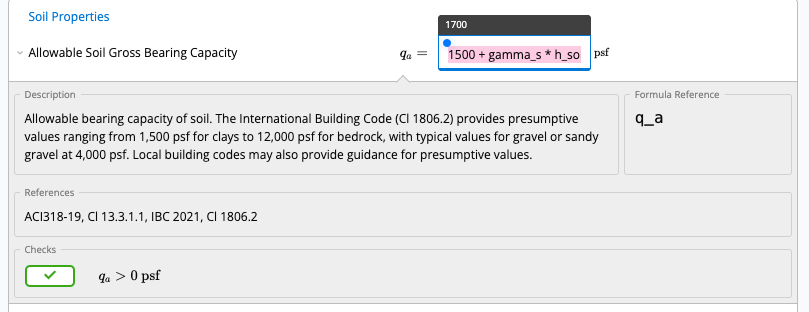
You must enter **1700 psf** into the input:
> **Allowable Soil Gross Bearing Capacity (qₐ)**
## 4.2.1 Entering the Conversion Directly in Calcs.com
In Calcs.com, you can enter this conversion **directly** into the **qa** input field.
Instead of manually calculating 1700 psf, simply type the full expression into the **qa** input:
```
1500 + gamma_s * h_soil
```
The calculator will evaluate this automatically and use the resulting **gross** allowable value in all bearing pressure checks.