United States

Spread Footing (IBC 2024)

Run the calc
Gross bearing pressure is the total pressure on the soil under a footing, including the footing’s self-weight and the soil above it. Net bearing pressure removes the weight of the soil the footing replaced. This article shows how the Calcs.com Spread Footing calculator works out both and how to enter a gross or net allowable value.

Worked example

Example 1: edit the starting values and convert a net allowable value

A geotechnical report gives a net allowable bearing capacity of 100 kPa, net of the footing weight and the soil above the footing. The calculation starts from a 2000 mm by 2000 mm footing, 600 mm thick, with a 350 mm square column on a 500 mm square base plate. The steps edit the footing size, the soil, the loads and the allowable value, and the results show the soil check. The run is on Spread Footing (IBC 2024), version 6, in a metric project. The edits are:
  • Footing Width and Footing Length: 2400 mm each, from 2000 mm
  • Depth of Soil Over Footing: 800 mm, from 600 mm
  • Unit Weight of Soil: 18 kN/m³, from 15.7 kN/m³
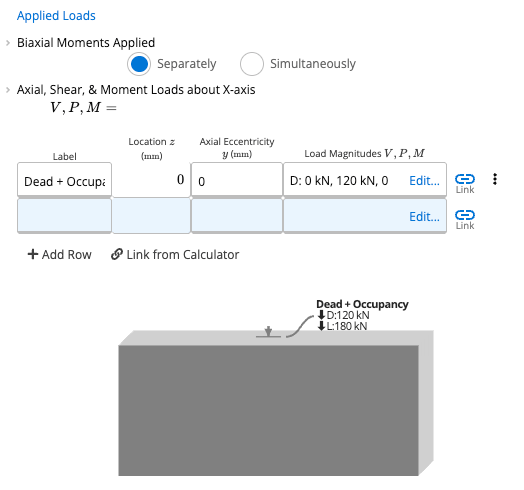
  • Loads: dead load 120 kN and live load 180 kN, from 100 kN and 150 kN
  • Allowable Soil Gross Bearing Capacity: the net value of 100 kPa, converted by the expression below
Everything else stays as it starts, including the 600 mm footing thickness, the column and base plate, and the Concrete Density of 23.6 kN/m³.
1

Edit the footing size

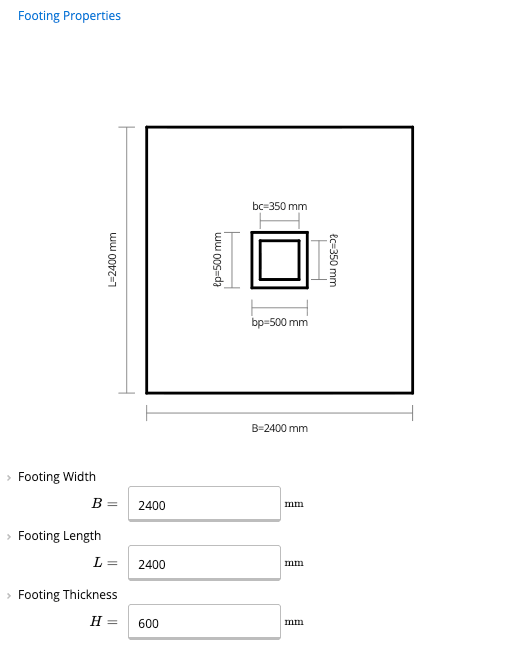
In Footing Properties, change the Footing Width and Footing Length to 2400 mm. The footing thickness stays 600 mm.Footing Properties with a diagram of a 2400 millimeter by 2400 millimeter footing with a 350 millimeter column and a 500 millimeter base plate, and the inputs Footing Width 2400, Footing Length 2400 and Footing Thickness 600 millimeters.
2

Edit the soil properties

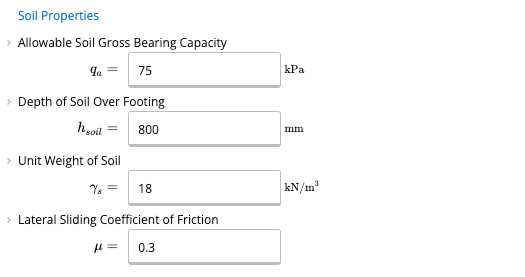
In Soil Properties, change the Depth of Soil Over Footing to 800 mm and the Unit Weight of Soil to 18 kN/m³.Soil Properties with an Allowable Soil Gross Bearing Capacity of 75 kilopascals, a Depth of Soil Over Footing of 800 millimeters, a Unit Weight of Soil of 18 kilonewtons per cubic meter, and a Lateral Sliding Coefficient of Friction of 0.3.
3

Convert the net allowable value

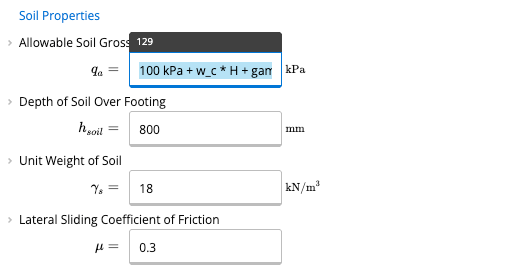
The report’s 100 kPa is a net value, so add back the footing weight and the soil above it. In Allowable Soil Gross Bearing Capacity, type:
A tooltip over the input shows the result, 129 kPa. When you leave the input, it holds that value.Allowable Soil Gross Bearing Capacity input holding an expression that starts 100 kPa + w_c * H, with a tooltip showing 129, above a Depth of Soil Over Footing of 800 millimeters and a Unit Weight of Soil of 18 kilonewtons per cubic meter.Allowable Soil Gross Bearing Capacity input after the expression is accepted, showing 129 kilopascals.
4

Edit the loads

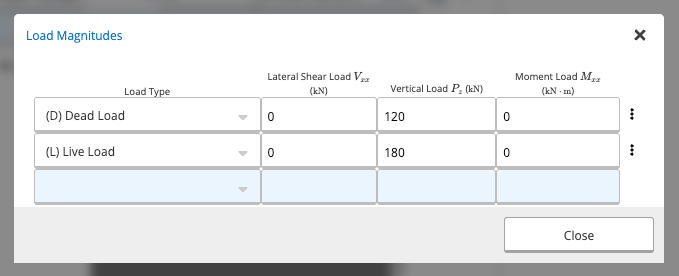
In Applied Loads, select Edit… on the Dead + Occupancy row. In Load Magnitudes, change the vertical load of the (D) Dead Load to 120 kN and of the (L) Live Load to 180 kN, then select Close.Load Magnitudes window with a (D) Dead Load row with a vertical load of 120 kilonewtons and an (L) Live Load row with a vertical load of 180 kilonewtons, each with a lateral shear load and a moment load of 0.Applied Loads with a Dead + Occupancy row at location 0 with a dead load of 120 kilonewtons and a live load of 180 kilonewtons, and a diagram of the footing with those loads.
5

Read the results

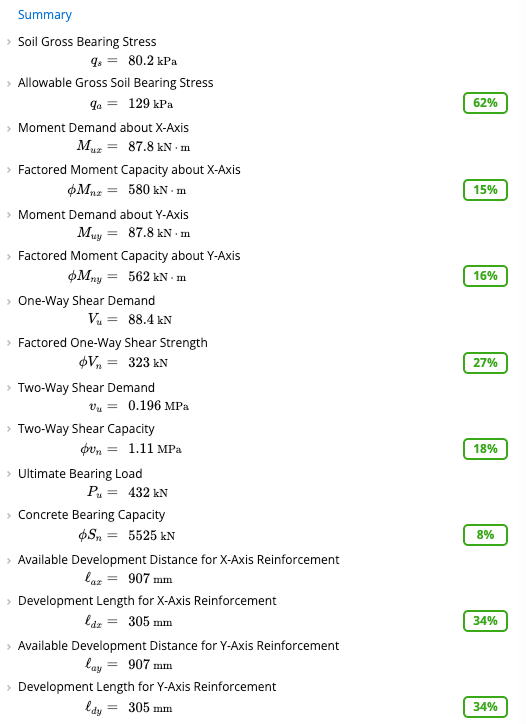
The Summary shows a Soil Gross Bearing Stress (qsq_s) of 80.2 kPa against an Allowable Gross Soil Bearing Stress of 129 kPa, with a 62% badge. The Ultimate Bearing Load (PuP_u) is 432 kN.Summary with a Soil Gross Bearing Stress of 80.2 kilopascals, an Allowable Gross Soil Bearing Stress of 129 kilopascals with a green 62 percent badge, moment, shear, bearing and development rows with their demands, capacities and badges, and an Ultimate Bearing Load of 432 kilonewtons.The badges at the top of the sheet show the same checks, with Bearing at 62% as the governing one.Header badges: Bearing 62 percent, X Moment 15 percent, Y Moment 16 percent, Shear 27 percent and Governing 62 percent.Near the loads, the calculator shows the Self Weight of Concrete Footing (SWSW), 81.4 kN, and the Weight of Soil above Footing (WsoilW_{soil}), 80.3 kN.Self Weight of Concrete Footing of 81.4 kilonewtons and Weight of Soil above Footing of 80.3 kilonewtons.
6

See how the gross stress is built

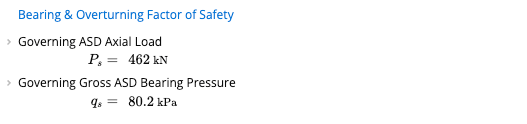
In Detailed mode (expand Details at the top right of the sheet and select Detailed), the Governing ASD Axial Load (PsP_s) is 462 kN: the largest unfactored axial load plus the footing self-weight and the weight of soil above the footing. With no moment applied, the Governing Gross ASD Bearing Pressure (qsq_s) is that load divided by the footing area, 80.2 kPa.Bearing and Overturning Factor of Safety with a Governing ASD Axial Load of 462 kilonewtons and a Governing Gross ASD Bearing Pressure of 80.2 kilopascals.
7

See the ultimate net pressure

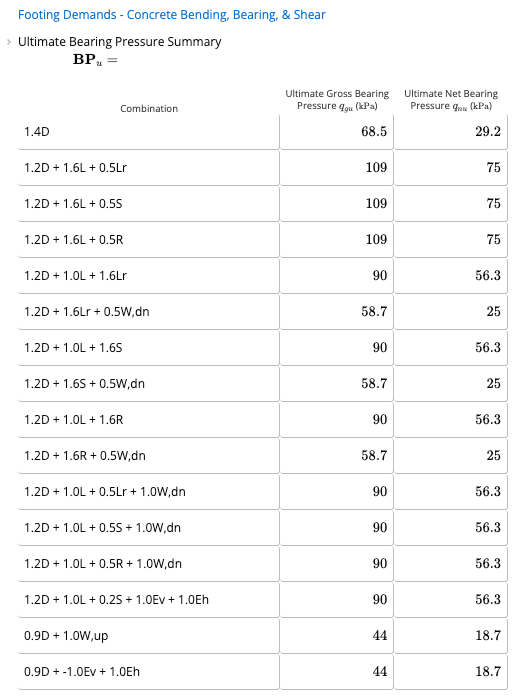
The Ultimate Bearing Pressure Summary lists the ultimate gross pressure (qguq_{gu}) and the ultimate net pressure (qnuq_{nu}) for each load combination. For 1.2D + 1.6L + 0.5Lr they are 109 kPa and 75 kPa. The Maximum Ultimate Axial Load (PumaxP_{umax}) is 432 kN, and the Maximum Ultimate Bearing Pressure with No Eccentricity is 75 kPa.Ultimate Bearing Pressure Summary table of load combinations with the ultimate gross and ultimate net bearing pressure in kilopascals for each: 1.4D gives 68.5 and 29.2, the 1.2D + 1.6L combinations give 109 and 75, 1.2D + 1.0L + 1.6Lr gives 90 and 56.3, the combinations with 0.5W,dn give 58.7 and 25, and the 0.9D combinations give 44 and 18.7.Maximum Ultimate Axial Load of 432 kilonewtons and Maximum Ultimate Bearing Pressure with No Eccentricity of 75 kilopascals.
Inputs, Calcs.com output and a hand check

Inputs

CalculatorSpread Footing (IBC 2024)
Footing width BB2400 mm
Footing length LL2400 mm
Footing thickness HH600 mm
Concrete density wcw_c23.6 kN/m³
Effective bearing beb_e, ℓe\ell_e425 mm
Depth of soil hsoilh_{soil}800 mm
Soil unit weight γs\gamma_s18 kN/m³
Net allowable qnaq_{na}100 kPa
Dead load DD120 kN
Live load180 kN

Calcs.com output

Allowable qaq_a (gross)129 kPa
Self weight SWSW81.4 kN
Soil weight WsoilW_{soil}80.3 kN
ASD axial load PsP_s462 kN
Soil gross stress qsq_s80.2 kPa
Against qaq_a62%
Ultimate load PuP_u432 kN
Ultimate gross qguq_{gu}109 kPa
Ultimate net qnuq_{nu}75 kPa

Hand check

✓Conversion: the sheet takes 150 pcf for Normalweight concrete, 23.56 kN/m³. qa=100+23.56×0.6+18×0.8=100+14.1+14.4=128.5q_a = 100 + 23.56 \times 0.6 + 18 \times 0.8 = 100 + 14.1 + 14.4 = 128.5 kPa, which the sheet shows as 129 kPa
✓Self weight: SW=23.56×2.4×2.4×0.6=SW = 23.56 \times 2.4 \times 2.4 \times 0.6 = 81.4 kN
✓Soil weight: Wsoil=18×(2.4×2.4−0.4252)×0.8=W_{soil} = 18 \times (2.4 \times 2.4 - 0.425^2) \times 0.8 = 80.3 kN, with the column’s effective bearing area taken out
✓The 1.0D + 1.0L combination gives 120 + 180 = 300 kN, so Ps=300+81.4+80.3=461.8P_s = 300 + 81.4 + 80.3 = 461.8 kN, and qs=461.8/(2.4×2.4)=q_s = 461.8 / (2.4 \times 2.4) = 80.2 kPa
✓80.2/128.5=80.2 / 128.5 = 62%, and Pu=1.2×120+1.6×180=P_u = 1.2 \times 120 + 1.6 \times 180 = 432 kN
✓The dead-load factor 1.2 gives Wuf=1.2×(81.4+80.3)=194W_{uf} = 1.2 \times (81.4 + 80.3) = 194 kN, so qgu=(432+194)/5.76=q_{gu} = (432 + 194) / 5.76 = 109 kPa and qnu=432/5.76=q_{nu} = 432 / 5.76 = 75 kPa, which is the factored load divided by the area

The conversion, weights, bearing stress, percentage, ultimate load and ultimate pressures match the closed-form solution. This is a sanity check only. Spread Footing (IBC 2024) version 6.

What this article covers

  • The difference between gross and net soil bearing pressure
  • Why geotechnical engineers typically provide net allowable bearing pressures
  • How Calcs.com computes gross and net bearing pressures using ASD and LRFD loads
  • How footing self-weight and overburden soil are incorporated into the calculations
  • How to correctly input gross or net allowable bearing capacity values from a geotechnical report

Symbols

These are the symbols used on this page, with the name the calculator shows where it has one.

1. What Is the Difference Between Gross and Net Bearing Pressure?

1.1 Gross Bearing Pressure

Gross pressure (qgq_g) is the total pressure acting on the soil under the footing. It includes:
  • Load from the structure (PP)
  • Self-weight of the footing (SWSW)
  • Weight of soil/backfill sitting above the footing (WsoilW_{soil})
Formula: qg=P+SW+WsoilAq_g = \frac{P + SW + W_{soil}}{A} For a load with no applied moment, this is the pressure the calculator reports as Soil Gross Bearing Stress (qsq_s). Section 3.1 covers an applied moment.

1.2 Net Bearing Pressure

Net pressure (qnetq_{net}) represents only the increase in pressure caused by the structure after excavation. It removes the weight of the soil that originally filled the space where the footing now sits. Formula: qnet=qg−γsDfq_{net} = q_g - \gamma_s D_f Where:
  • γs\gamma_s = unit weight of soil
  • DfD_f = depth from ground surface to the footing base
The calculator reports: Ultimate Net Bearing Pressure (qnuq_{nu}).

2. Why Geotechnical Engineers Usually Give Net Allowable Pressure

Geotechnical field tests measure soil behavior at depth before excavation. Because the soil originally carried its own self-weight, engineers often subtract this “overburden” from the allowable capacity. This is why reports often say:
“Allowable bearing pressure: net of footing weight and overburden.”
Meaning:
  • Footing weight should not be counted against the allowable capacity.
  • Only the structural load increase matters.

3. How the Calcs.com Calculator Computes Bearing Pressure

The calculator performs two distinct sets of calculations: one for checking the soil (ASD) and one for designing the concrete (LRFD).

3.1 The Soil Check (ASD): Calculating Gross Stress

To check if the soil will settle or fail, Calcs.com calculates the Soil Gross Bearing Stress (qsq_s), shown in Detailed mode as the Governing Gross ASD Bearing Pressure. This uses Unfactored (ASD) loads. The calculator sums the structural loads, the footing self-weight, and the soil surcharge weight. The sheet calls the result the Governing ASD Axial Load (PsP_s): Ptotal=PASD+SW+WsoilP_{total} = P_{ASD} + SW + W_{soil} When no moment is applied, it divides by the footing area to find the applied stress: qs=PtotalB×Lq_s = \frac{P_{total}}{B \times L} Where:
  • PASDP_{ASD} = Governing unfactored service load.
  • SWSW = Self Weight of Concrete Footing: wc×B×L×Hw_c \times B \times L \times H, the Concrete Density times the Footing Width, Length and Thickness.
  • WsoilW_{soil} = Weight of Soil above Footing: γs×(L×B−beℓe)×hsoil\gamma_s \times (L \times B - b_e \ell_e) \times h_{soil}, the Unit Weight of Soil times the footing area less the column’s effective bearing area, times the Depth of Soil Over Footing.
When a moment is applied, qsq_s is instead the peak pressure from the calculator’s bearing pressure tables for the bending direction, not the average above. This result (qsq_s) is compared directly against your input for Allowable Soil Gross Bearing Capacity (qaq_a). The Summary shows that input as Allowable Gross Soil Bearing Stress.

3.2 The Concrete Design (LRFD): Calculating Net Stress

To design the steel reinforcement and check shear strength, the calculator must determine the force trying to bend the footing upwards. This uses Factored (LRFD) loads. The calculator computes the Ultimate Net Bearing Pressure (qnuq_{nu}). This pressure excludes the weight of the footing and soil because those gravity loads act downwards, canceling out the upward soil pressure they create. How it is calculated in the internal logic:
1

Calculate the ultimate gross pressure

The calculator takes the maximum factored structural load (PuP_u) plus the factored weight of the footing and soil (WufW_{uf}) to find the ultimate gross pressure (qguq_{gu}):qgu=Pu+WufB×Lq_{gu} = \frac{P_u + W_{uf}}{B \times L}
2

Subtract the weight to find the net pressure

The calculator then subtracts the factored weight of the footing and soil to find the ultimate net pressure (qnuq_{nu}):qnu=qgu−WufB×Lq_{nu} = q_{gu} - \frac{W_{uf}}{B \times L}
These two steps are the case with no applied moment. With a moment, the calculator takes the pressure from its tables for the bending direction instead, as it does for qsq_s. Result:
With no applied moment, the Ultimate Net Pressure (qnuq_{nu}) is effectively just the factored structural load (PuP_u) divided by the area.
This is the pressure used to calculate bending moments (MuM_u) and shear (VuV_u) in the concrete.

3.3 What Is the Factored Weight of the Footing and Soil?

WufW_{uf} represents the factored weight of:
  • the concrete footing (self-weight SW)
  • the soil above the footing (WsoilW_{soil})
Calcs.com applies the LRFD dead-load factor directly: Wuf=(DL Factor)⋅(SW+Wsoil)W_{uf} = (\text{DL Factor}) \cdot (SW + W_{\text{soil}}) This ensures consistency with ACI 318 LRFD load combinations.

How to use it

The steps below follow the inputs that feed the bearing calculation, in the order they appear in the calculator. The reinforcement and design criteria inputs are not covered here; see Design a Spread Footing (IBC 2024).
1

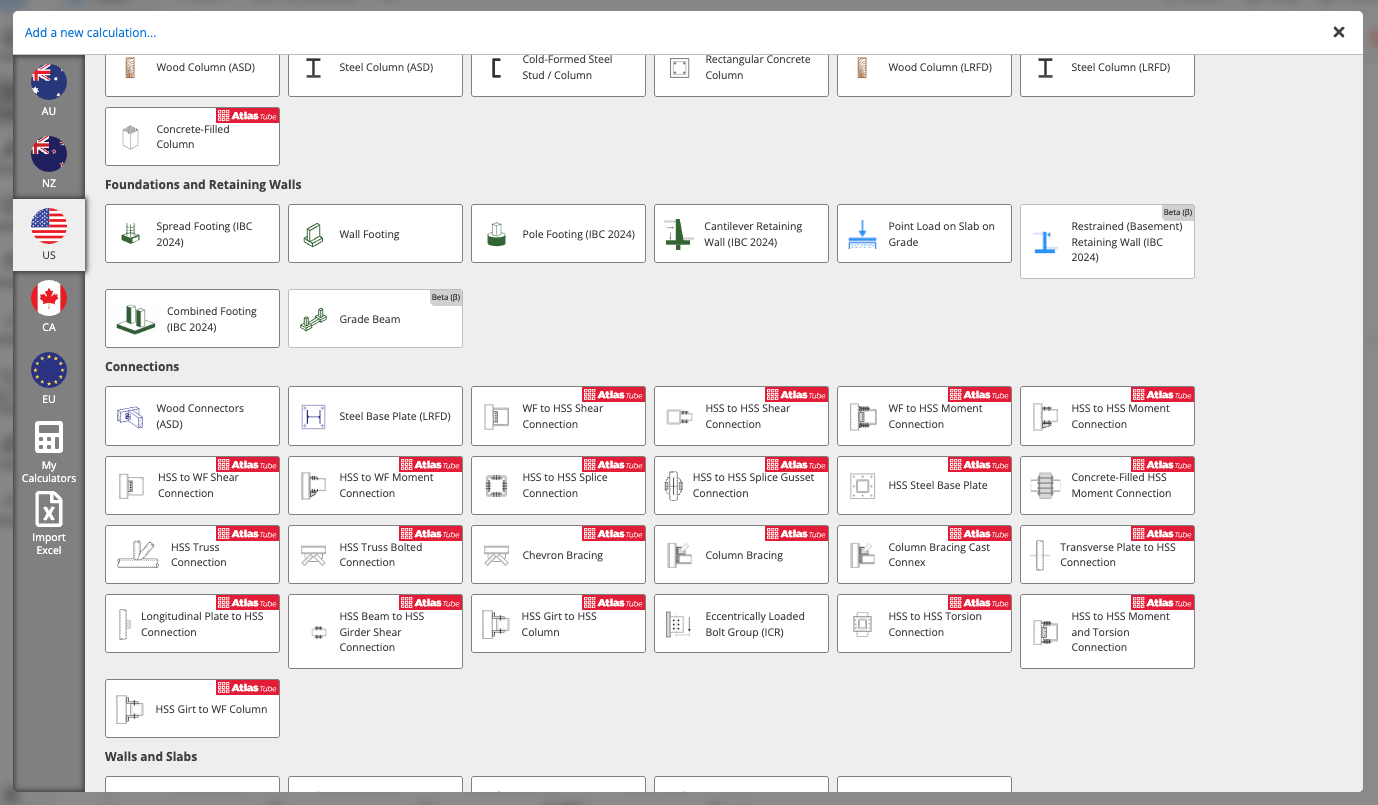
Add the Spread Footing calculator

In your project, choose Add New Calculation, select US, and choose Spread Footing (IBC 2024) under Foundations and Retaining Walls.Add a new calculation window with the US region selected and the Foundations and Retaining Walls group listing Spread Footing (IBC 2024), Wall Footing, Pole Footing (IBC 2024), Cantilever Retaining Wall (IBC 2024), Point Load on Slab on Grade, Restrained (Basement) Retaining Wall (IBC 2024), Combined Footing (IBC 2024) and Grade Beam.
2

Set the footing size and the concrete
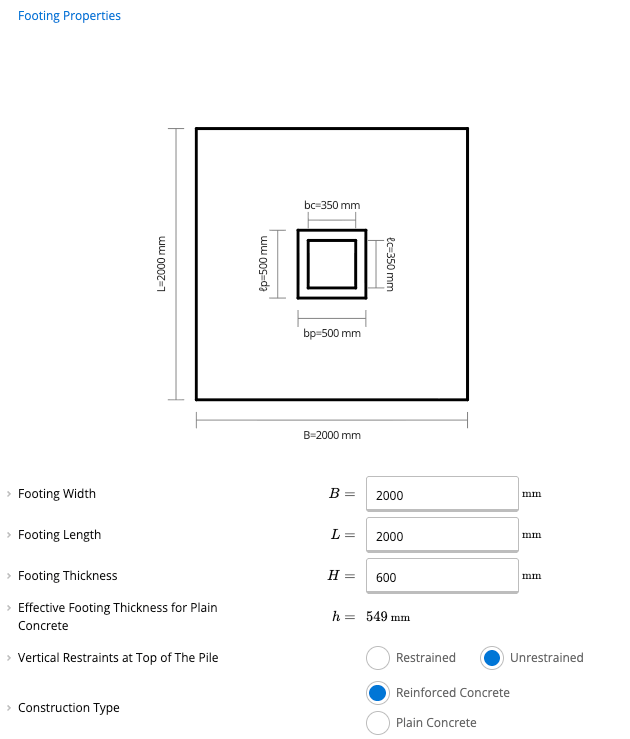
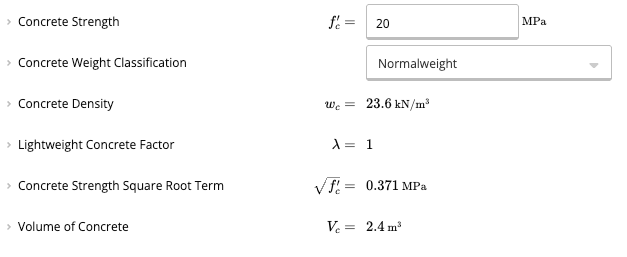
In Footing Properties, enter the Footing Width (BB), Footing Length (LL) and Footing Thickness (HH). The diagram shows them with the column and base plate.Footing Properties section with a diagram of a 2000 millimeter by 2000 millimeter footing, a 350 millimeter column and a 500 millimeter base plate, and the inputs Footing Width 2000, Footing Length 2000 and Footing Thickness 600 millimeters, an effective footing thickness for plain concrete of 549 millimeters, Vertical Restraints at Top of The Pile set to Unrestrained, and Construction Type set to Reinforced Concrete.Further down, the Concrete Weight Classification sets the Concrete Density (wcw_c). Normalweight gives 23.6 kN/m³, which the calculator uses for the footing self-weight.Concrete properties with a Concrete Strength of 20 megapascals, a Concrete Weight Classification of Normalweight, a Concrete Density of 23.6 kilonewtons per cubic meter, a Lightweight Concrete Factor of 1, a Concrete Strength Square Root Term of 0.371 megapascals and a Volume of Concrete of 2.4 cubic meters.
3

Describe the column

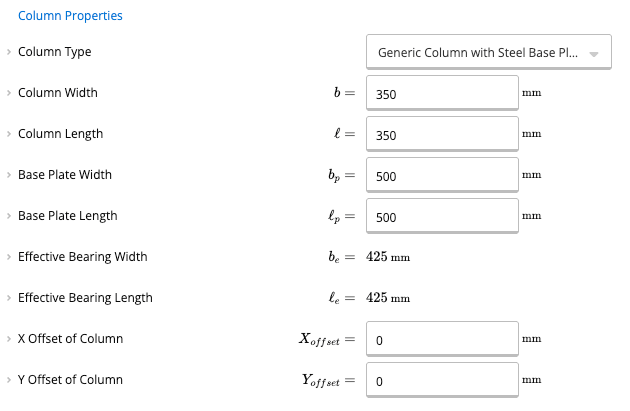
In Column Properties, choose the Column Type and enter the column width and length and the base plate width and length. The calculator works out the Effective Bearing Width (beb_e) and Effective Bearing Length (ℓe\ell_e): for a column on a steel base plate it takes the width halfway between the column and the base plate. The X and Y offsets of the column stay at 0.Column Properties section with a Column Type of Generic Column with Steel Base Plate, a column width and length of 350 millimeters, a base plate width and length of 500 millimeters, an Effective Bearing Width and Length of 425 millimeters, and X and Y offsets of the column of 0.
4

Enter the soil properties

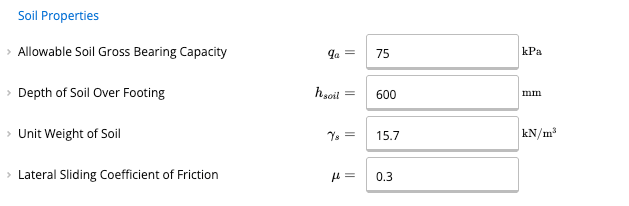
In Soil Properties, enter the Allowable Soil Gross Bearing Capacity (qaq_a), the Depth of Soil Over Footing (hsoilh_{soil}) and the Unit Weight of Soil (γs\gamma_s). Select a label to see its description, references and check. The Lateral Sliding Coefficient of Friction has its own input.Soil Properties section with an Allowable Soil Gross Bearing Capacity of 75 kilopascals, a Depth of Soil Over Footing of 600 millimeters, a Unit Weight of Soil of 15.7 kilonewtons per cubic meter, and a Lateral Sliding Coefficient of Friction of 0.3.
5

Enter the loads

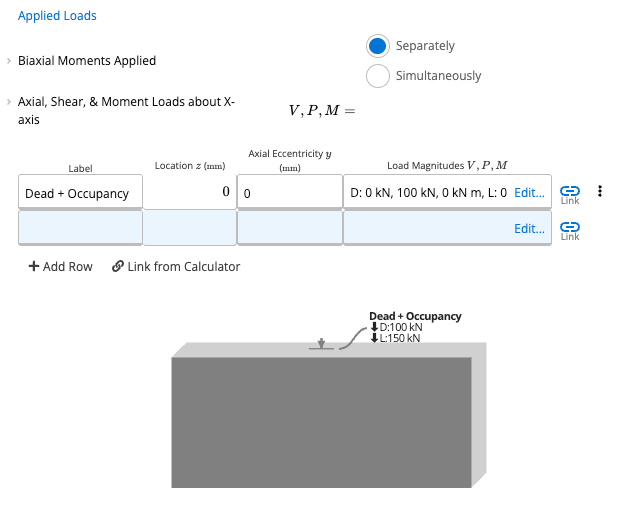
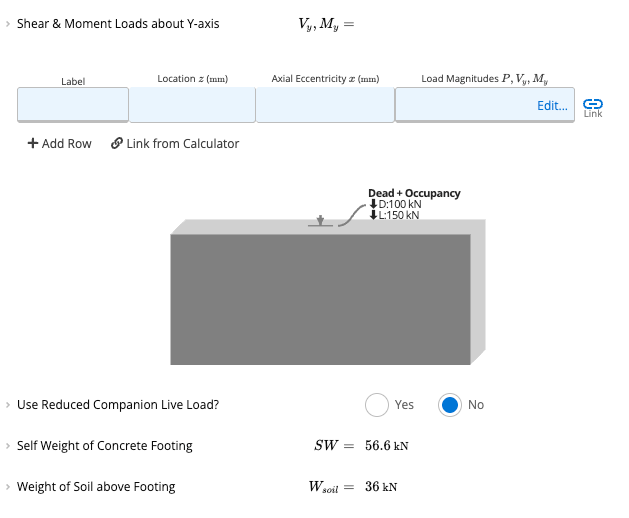
In Applied Loads, the table for loads about the X-axis has a row for each load. This example has one row, Dead + Occupancy, with a dead load of 100 kN and a live load of 150 kN. Select Edit… to open the load magnitudes. Use Reduced Companion Live Load? is No.Applied Loads section with Biaxial Moments Applied set to Separately, a table of axial, shear and moment loads about the X-axis with a Dead + Occupancy row at location 0 with a dead load of 100 kilonewtons and a live load of 150 kilonewtons, and a diagram of the footing with those loads.Below the load tables, the calculator shows the Self Weight of Concrete Footing (SWSW), 56.6 kN here, and the Weight of Soil above Footing (WsoilW_{soil}), 36 kN here.Shear and Moment Loads about Y-axis table, empty, with a diagram of the footing, Use Reduced Companion Live Load set to No, a Self Weight of Concrete Footing of 56.6 kilonewtons and a Weight of Soil above Footing of 36 kilonewtons.
6

Read the summary

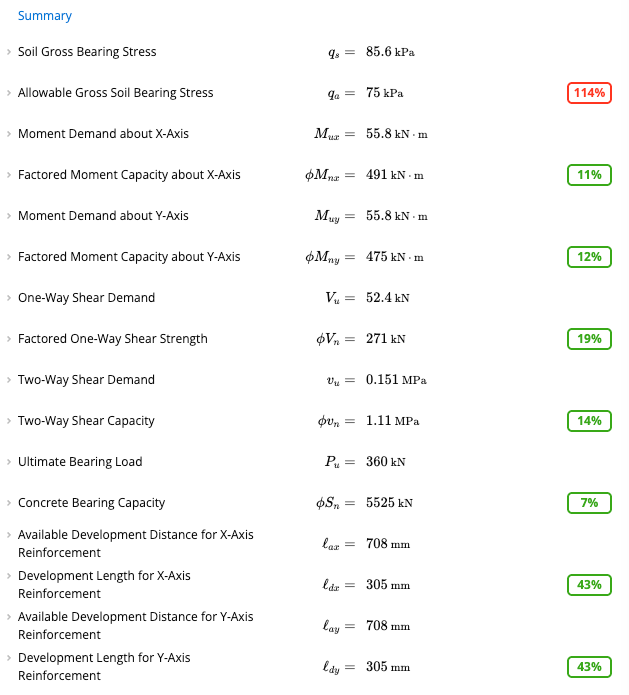
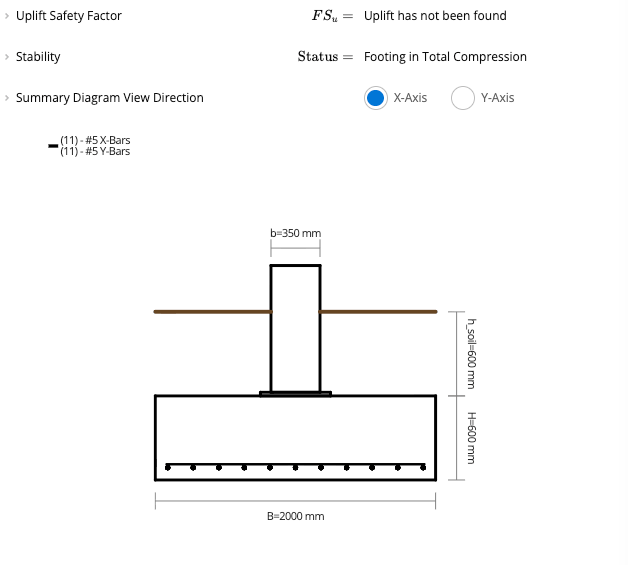
The Summary shows the Soil Gross Bearing Stress (qsq_s) next to the Allowable Gross Soil Bearing Stress with a percentage badge, then the concrete demands and capacities. The diagram at the end shows the Depth of Soil Over Footing above the top of the footing and the footing thickness.Summary with a Soil Gross Bearing Stress of 85.6 kilopascals, an Allowable Gross Soil Bearing Stress of 75 kilopascals with a red 114 percent badge, moment demands and capacities, shear demands and capacities, an Ultimate Bearing Load of 360 kilonewtons, a Concrete Bearing Capacity of 5525 kilonewtons and the development distances and lengths.Footing elevation diagram with a column on a base plate on a footing, a footing width of 2000 millimeters, a column width of 350 millimeters, a soil depth of 600 millimeters above the footing and a footing thickness of 600 millimeters, below the Uplift Safety Factor and Stability rows.

Entering a gross or net allowable value

If your geotechnical report gives Gross Allowable Bearing Capacity

Enter it directly into:
Allowable Soil Gross Bearing Capacity (qaq_a)

If your geotechnical report gives Net Allowable Bearing Capacity

When the geotechnical engineer provides a net allowable bearing capacity (qnaq_{na}), you must convert it to a gross allowable value before entering it into Calcs.com. The calculator’s Soil Gross Bearing Stress includes the footing self-weight and the soil above the footing, so a net value that excludes them needs them added back. Use the conversion: qa=qna+wcH+γshsoilq_a = q_{na} + w_c H + \gamma_s h_{soil} Where:
  • qnaq_{na} = net allowable bearing capacity
  • wcw_c = Concrete Density
  • HH = Footing Thickness
  • γs\gamma_s = Unit Weight of Soil
  • hsoilh_{soil} = Depth of Soil Over Footing
This assumes the report’s net value excludes the footing weight and the soil above the footing, as in the wording in section 2. If your report defines net differently, for example as in section 1.2, confirm the definition with the geotechnical engineer before converting. The calculator takes the soil area as the footing area less the column’s effective bearing area, so this conversion is slightly approximate. Enter the result into:
Allowable Soil Gross Bearing Capacity (qaq_a)

Entering the conversion directly in Calcs.com

The qaq_a input accepts an expression, so you can enter the conversion directly instead of calculating it by hand. Use the sheet’s variable names: w_c for the Concrete Density, H for the Footing Thickness, gamma_s for the Unit Weight of Soil and h_soil for the Depth of Soil Over Footing. For a net value of 100 kPa, type:
Write the unit after the net value. A bare number added to terms that carry units is not read as kPa. The calculator evaluates the expression automatically and uses the resulting gross allowable value in all bearing pressure checks.

Common questions

Gross bearing pressure is the total pressure on the soil under the footing: the structural load, the footing self-weight and the soil above the footing. Net bearing pressure is the increase in pressure caused by the structure after excavation, so it removes the weight of the soil that filled the space before.
Enter a gross value in Allowable Soil Gross Bearing Capacity. If your geotechnical report gives a net allowable value, add back the footing weight and the soil above it: gross equals net plus Concrete Density times Footing Thickness plus Unit Weight of Soil times Depth of Soil Over Footing. This assumes the report’s net value excludes both.
No. The soil check compares the Soil Gross Bearing Stress with your allowable value using unfactored (ASD) loads. Factored (LRFD) loads are used to design the concrete, through the Ultimate Net Bearing Pressure.
Yes. The Allowable Soil Gross Bearing Capacity input accepts an expression, for example 100 kPa + w_c * H + gamma_s * h_soil. The calculator evaluates it and uses the result as the gross allowable value. Write the unit after the net value.

Next steps

Design a Spread Footing (IBC 2024)

Design isolated spread footings to ACI 318-19 per IBC 2024 (ASCE 7-22): bearing, flexure, one-way and punching shear, and development length.

Design a Combined Footing to ACI 318-19

Design combined rectangular footings for two columns to ACI 318-19 per IBC 2024: bearing, overturning, sliding, flexure, shear and development length.