

Note: SDPWS 2021, Section 4.3.2 also defines a third type: Force-Transfer Around Openings (FTAO) Shear Walls (Section 4.3.2.2), which requires rational analysis for force transfer around openings. This method is not currently implemented in the Calcs.com calculator.
Segmented Method
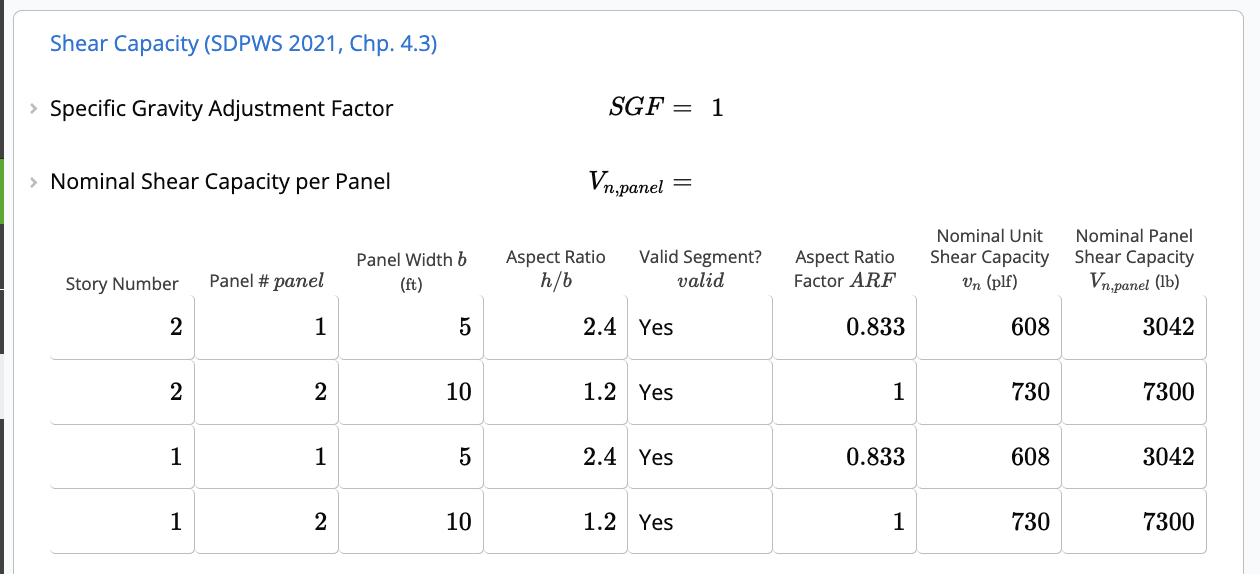
In the Segmented Method (referred to as Individual Full-Height Wall Segments in SDPWS 4.3.2.1), the shear wall is treated as a series of individual, full-height shear segments. Each opening essentially divides the wall into separate panels.- How it works: Each full-height segment is designed individually. The total shear load is distributed to these segments based on their relative stiffness (width).
- Treatment of Openings: Openings are permitted to occur beyond the ends of a shear wall segment, but the length of such openings is not included in the length of the shear wall.
- Holdowns: This method typically requires that holdowns be installed at the ends of every shear wall segment. This means you will need holdowns beside every opening.
- Collectors: Collectors must be provided to transfer shear forces between the diaphragm and the individual full-height wall segments.
- Pros: Generally provides slightly higher strength capacities compared to the perforated method.
- Cons: Requires significantly more hardware (holdowns) and detailing.
Calcs.com Note: Aligned Openings
For multi-story Segmented shear walls in Calcs.com, openings are assumed to be aligned vertically (stacked on top of each other). If you have offset openings on different floors, you may need to model them as separate wall lines.
For multi-story Segmented shear walls in Calcs.com, openings are assumed to be aligned vertically (stacked on top of each other). If you have offset openings on different floors, you may need to model them as separate wall lines.
Perforated Method
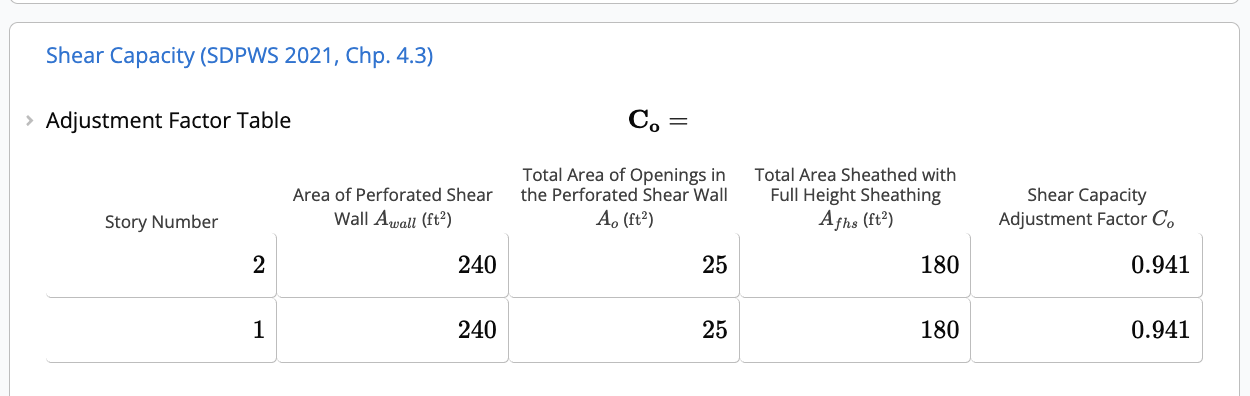
In the Perforated Method (referred to as Perforated Shear Walls in SDPWS 4.3.2.3), the entire length of the shear wall is considered as a single unit, rather than breaking it into strips.- How it works: The capacity is calculated for the whole wall and then adjusted using an empirical factor (). This factor accounts for the reduction in strength caused by the area of the openings.
- Structural Requirements:
- A perforated shear wall segment (full-height) must be located at each end of the perforated shear wall.
- The wall must have uniform top-of-wall and bottom-of-wall elevations.
- Collectors for shear transfer must extend for the full length of the perforated shear wall.
- Holdowns: This method offers a distinct advantage in detailing; it typically only requires holdowns at the very ends of the shear wall system, rather than at every opening.
- Capacity Limit: Per SDPWS 4.3.2.3, the nominal unit shear capacity for single-sided and double-sided walls shall not exceed 2,435 plf.
- Pros: Simplified detailing and reduced hardware costs (fewer holdowns).
- Cons: Generally results in slightly lower allowable shear capacities.
- Limitations: The perforated method is strictly limited to story heights of 20 feet or less.
Summary Comparison
Note: Treatment of Openings
- Segmented: Shear panels are created based strictly on the distance between openings. The wall areas immediately above and below openings are not considered in the capacity calculation.
- Perforated: The exact dimensions of openings must be entered, as the total area of openings () directly impacts the shear capacity adjustment factor (). Framing members and blocking around these openings are not designed for force transfer.