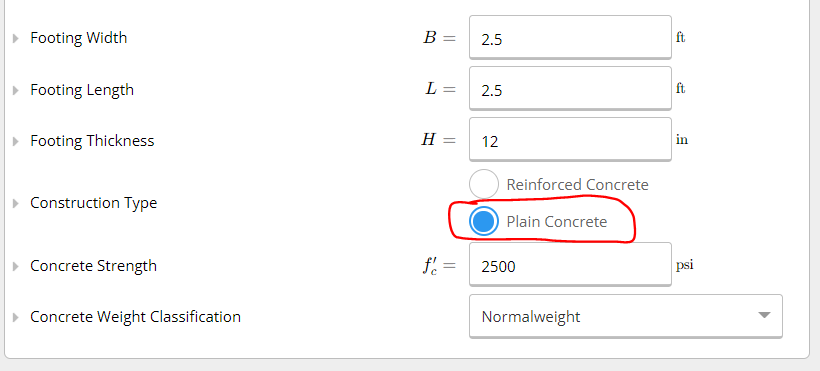
- Switch to plain concrete construction:

- If your footing doesn’t pass when switching to plain concrete, consider increasing thickness by an inch or two
- If that didn’t work, you need to switch back to reinforced concrete and develop your rebar. There are a few ways to deal with this:
- Use smaller bar sizes
- If the footing is thick enough to allow for it, hook the ends:

- Increase the footing width to allow enough development length
- Increase concrete strength (this has relatively little impact)
What is Development Length?
Steel reinforcement (rebar) in concrete footings generally acts in tension to resist bending loads that arise as the footing spreads loads uniformly over the soil underneath. However, those tension loads have to be transmitted between the concrete (where the load is applied) and the rebar. For this to happen, there has to be enough “grip” between the concrete and the rebar - otherwise the rebar would just get ripped right out of the concrete! Because rebar breaking out of concrete is generally an undesirable scenario (think a sudden bang with no warning), engineers generally ensure that there’s enough grip between concrete and rebar to ensure that the rebar reaches its full yield strength. That lets us use the full strength of the steel for greater efficiency, and is accompanied by large movements that’ll give plenty of warning to occupants. The length of rebar required to achieve the necessary grip is what we call the development length. Since the rebar can be considered “ineffective” over its development length, it’s desirable to minimize this length as much as possible. The most common way to reduce this length is to add ribs to the rebar, which grip the concrete around them. Another solution often employed is to “hook” bars by bending the ends 90 degrees, which significantly reduces the required development length at the expense of having to bend rebar and fitting the “hooks”. Note that the bigger the bar, the longer the development length required, as they can take more force! Code Requirements for Development Length
As previously described, it’s generally very desirable to “fully develop” bars, which means providing enough development length that the rebar can reach its full yield strength before ripping out the concrete. This is also reflected in building codes, which will almost always require that rebar be fully developed. For instance, ACI 318-19, the concrete design standard principally used in the USA, provides equations for development length that directly depend on the yield strength of the rebar. The equation below is taken directly from ACI 318-19, as implemented in Calcs.com.
 Providing this development length is an essential part of reinforced concrete design. Formulas and methods used to analyze the strength of concrete members are practically all dependent on the assumption that the rebar can reach its full yield strength. Thus, not providing enough development length can very much lead to premature failures.
However, to account for the fact that it may be impractical to reach full development lengths in some situations (the largest bars can require over 10 feet of development length!), the code also allows reducing the development length, in some cases, as a proportion of the required steel vs what is provided. So if far more steel is provided than is required, the development length may be reduced - but only down to a hard limit of 12 inches, and it can’t apply to reinforcement provided for things like increased ductility or when resisting seismic loads.
Providing this development length is an essential part of reinforced concrete design. Formulas and methods used to analyze the strength of concrete members are practically all dependent on the assumption that the rebar can reach its full yield strength. Thus, not providing enough development length can very much lead to premature failures.
However, to account for the fact that it may be impractical to reach full development lengths in some situations (the largest bars can require over 10 feet of development length!), the code also allows reducing the development length, in some cases, as a proportion of the required steel vs what is provided. So if far more steel is provided than is required, the development length may be reduced - but only down to a hard limit of 12 inches, and it can’t apply to reinforcement provided for things like increased ductility or when resisting seismic loads.
Development Length in Footings
When calculating the rebar required in footings, we look at a critical section for bending moment, generated by the action of load being spread uniformly from the column to the entire area of the footing. As you can see on the image below, the available length for development of the rebar is the distance between the column face and the footing edge, less the concrete cover.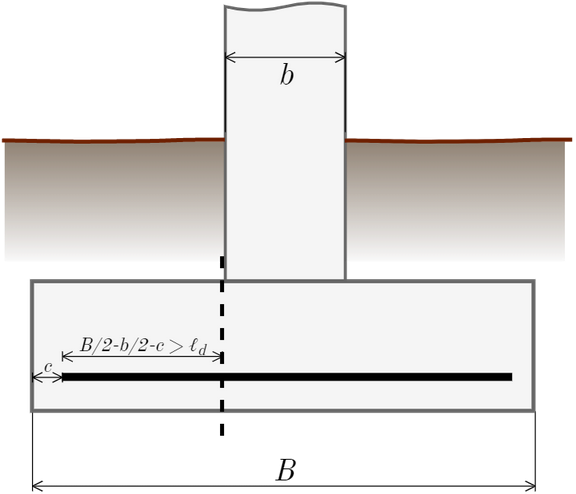 In larger footings such as used in commercial buildings, it’s generally never an issue to achieve development of the rebar. However, in smaller footings such as in residential construction, this can be a problem. Even when using small bar sizes and applying all the reductions allowed by the ACI 318-19 code, we’re still left with the 12” hard limit on development length, which, if combined with 3” cover and assuming a 6”x6” post, means we need a footing at least 3 feet wide. This may often be larger than typical construction practices, which have been proven time and time again to be sufficient. So how do we accommodate this? Let’s look at one solution…
Plain Concrete - No Development Required!
If we don’t want to deal with rebar development length, there’s one simple solution: skip the rebar! Indeed, the ACI code specifically allows concrete footings to be designed without any rebar, using the small tensile capacity of concrete to resist the bending loads we discussed previously. In reality, this winds up being more of an “arch” action, where load gets spread in compression diagonally into the soil below. When using these provisions, there’s nothing saying we can’t actually still include rebar in there - just that we can’t consider it to strengthen the footing. Specifically with small residential footings where loads are small and the footings relatively “stubby”, it’s almost always the case that footings will be adequate when considering only the plain concrete. So if you’ve had the same typical detail for small footings calling out a small grid of #5 rebars for the last two decades and were surprised to find that it wasn’t passing due to development length, fear not! The best way to handle this in Calcs.com is to design as Plain Concrete, and simply to specify your desired rebar pattern in your drawings afterwards.