

Example 1 - Unequal Leg Angle, Long Leg Up
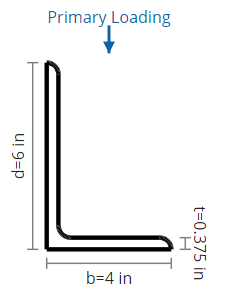
Reference: Whitney McNulty, Single Angle Design Manual, 2008, Example 4.5, p. 4-66 In this example, we find the flexural capacity of an unequal leg angle with the long leg up. Note that in the reference, no loads are calculated, only capacity. A uniformly distributed load is assumed. Only nominal loads are looked at thus the distinction between ASD or LRFD does not matter here. Strength calculations are based on the principal axis, and at the end converted to the geometric X-axis.Inputs
| Parameter | Value |
|---|---|
| Cross-section | L6x4x3/8 |
| Angle Orientation | Long leg up |
| Yield Strength | 36 ksi |
| Length | 8’ |
| Lateral Bracing | Unbraced |
| Support Conditions | Simply Supported |
 |
Outputs
*The formula for the elastic LTB moment changed slightly between the 2005 AISC Specification (used in the example) and the 2016 AISC Specification (used by Calcs.com), which is the reason for the differences here.
**The example splits deflection components in their horizontal and vertical components, while Calcs.com currently only reports the vector sum of the components.
Example 2 - Unequal Leg Angle, Short Leg Up
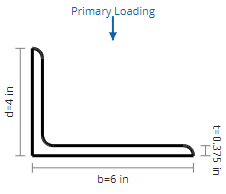
Reference: Whitney McNulty, Single Angle Design Manual, 2008, Example 4.8, p. 4-85 In this example, we find the flexural capacity of an unequal leg angle with the short leg down. Note that in the reference, no loads are calculated, only capacity. A uniformly distributed load is assumed. Only nominal loads are looked at thus the distinction between ASD or LRFD does not matter here. Strength calculations are based on the principal axis, and at the end converted to the geometric X-axis.Inputs
| Parameter | Value |
|---|---|
| Cross-section | L6x4x3/8 |
| Angle Orientation | Short leg up |
| Yield Strength | 36 ksi |
| Length | 8’ |
| Lateral Bracing | Unbraced |
| Support Conditions | Simply Supported |
 |
Outputs
*The formula for the elastic LTB moment changed slightly between the 2005 AISC Specification (used in the example) and the 2016 AISC Specification (used by Calcs.com), which is the reason for the differences here.
**The example splits deflection components in their horizontal and vertical components, while Calcs.com currently only reports the vector sum of the components.