What it calculates
Determine MWFRS wind pressures on low-rise buildings to NBCC 2020 (Subsection 4.1.7) for both orthogonal load cases. Builds the velocity pressure, exposure, gust and topographic factors, resolves the Figure 4.1.7.6 zone coefficients including end zones, and reports net ULS and SLS pressures against both internal pressure conditions.
Who uses this calculator
Canadian structural engineers setting the lateral design pressures on a low-rise building frame under NBCC 2020, where both orthogonal load cases and the end-zone widths have to be resolved before any bracing or diaphragm work starts. Hill and escarpment speed-up is built in for sites where topography governs.
Likely replaces 1-2 hours per building of manual code lookups and hand calculation across velocity pressure, exposure/gust/topographic factors, and Table 4.1.7.6 pressure coefficients for both load cases.
How it calculates
This calculator determines wind pressures on the main wind-force-resisting system (MWFRS) of a low-rise building using the static procedure of the National Building Code of Canada 2020 (Division B, Part 4, Subsection 4.1.7). It builds the velocity pressure, applies exposure, gust and topographic effects, then resolves the Figure 4.1.7.6 zone coefficients for both orthogonal load cases.
Reference velocity pressure and importance factors
The reference velocity pressure q50 is the 1-in-50 annual probability value for the site, taken from the project defaults or entered as an override. The building importance category sets the wind importance factor, which differs between ultimate and serviceability limit states, so both are carried through the calculation in parallel.
Building geometry and reference height
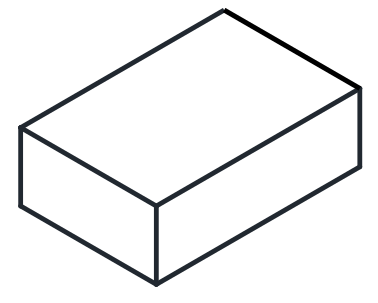
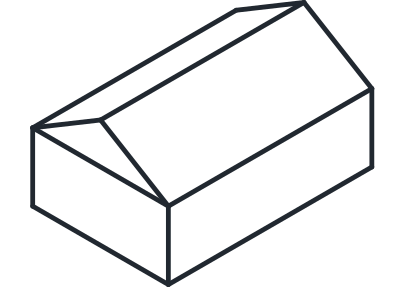
Roof type and pitch give the roof angle, from which the eave height, mean roof height and the reference height used for the exposure factor are derived. The building width perpendicular to the ridge and length parallel to it set the least horizontal dimension, which in turn drives the end-zone geometry.
End-zone widths
The end-zone width z is taken as
z = max( min(0.10 × Bmin, 0.40 × H), max(0.04 × Bmin, 1 m) )
where Bmin is the least horizontal dimension and H the building height used for the figure. The wider end-zone dimension y follows as max(6 m, 2z). These two dimensions define where the end-zone coefficients 1E through 6E apply rather than the interior zone values.
Exposure, gust and topographic factors
The exposure factor Ce is computed from the reference height and the terrain type, with the intermediate terrain case interpolating on the extent of rough terrain upwind and subject to the code floor on the factor. The gust effect factor Cg for the main structural system is taken as the code value for this procedure.
Where a hill or escarpment is present, the maximum speed-up ratio is derived from the hill height and the effective upwind distance for the selected shape, then attenuated by the horizontal distance from the peak and the height above ground. The resulting speed-up is combined with the gust factor to give the topographic factor:
Ct = (1 + ΔS / Cg) × (1 + ΔS)
Where no topographic feature is present, or the hill is too shallow to trigger the provisions, Ct is unity.
External pressure coefficients
The gust-pressure coefficient product CgCp is read from the Figure 4.1.7.6 zone system. Load Case A covers wind normal to the ridge using zones 1, 2, 3 and 4 plus end zones 1E to 4E. Load Case B covers wind parallel to the ridge and extends the set with zones 5 and 6 plus end zones 5E and 6E. Coefficients vary with roof angle and are interpolated across the code breakpoints, so a roof pitch between tabulated angles is handled without rounding to the nearest listed value.
External and net pressures
The external pressure on each zone is
p,ext = IW × q50 × Ce × Ct × CgCp
The internal pressure is derived from the building opening condition, which sets the positive and negative internal pressure coefficients, factored by the internal exposure and internal gust factors. The net pressure on each zone is then the external pressure less the internal pressure:
p,net = p,ext − p,i
Because the internal pressure can act outward or inward, every zone is reported twice, once against the positive internal condition and once against the negative, at both ULS and SLS. This gives four net pressure values per zone per load case, from which the governing value for any given frame element can be selected.