What it calculates
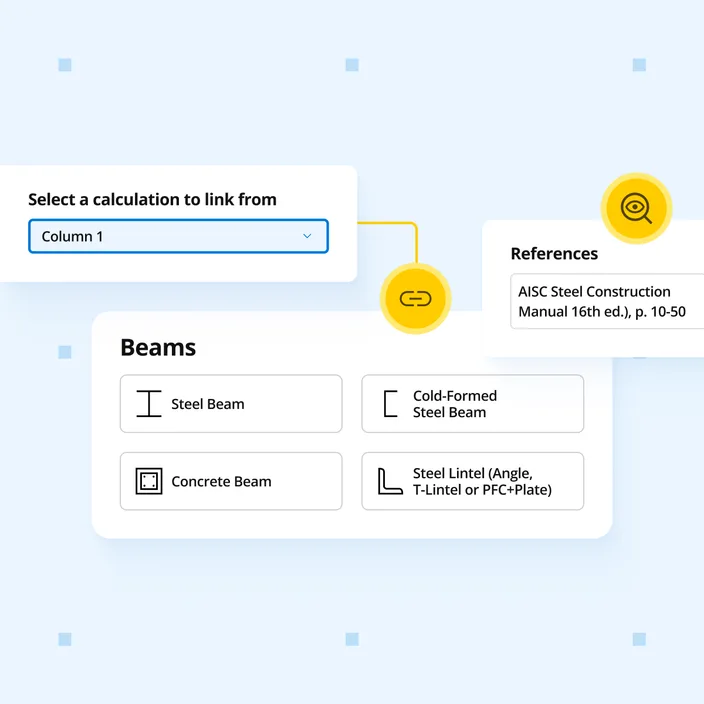
Beam reactions link to your column calculations, so load changes propagate downstream automatically. Design steel beams to CSA S16:19 with multiple supports and loads. Checks cover factored moment and shear resistance, section class, lateral torsional buckling via the omega-2 factor, and short- and long-term deflection limits.
Who uses this calculator
Beam reactions link to your column and supporting beam calculations automatically - change a load once and everything downstream updates. Designed for Canadian structural engineers working to CSA S16:19 and NBCC 2015, this calculator checks factored moment resistance, shear resistance, and deflection limits for W, S, M, HP, C, MC, HSS and pipe sections across simple, continuous, and cantilevered spans.
How it calculates
Structural model
A finite element solver computes reactions, bending moment, shear force, and deflection diagrams under each load combination. You define supports (pinned, roller, fixed, or hinge) and top or bottom flange braces at any position along the beam.
Load combinations (NBCC 2015 / CSA S16:19)
Loads are entered unfactored by type: dead (D), live (L), roof live (Lr), snow, wind (downward and uplift), and seismic (Eh, Ev). The calculator generates the default NBCC 2015 ultimate limit state (ULS) combinations and evaluates each one, for example:
- 1.25D + 1.5L
- 1.25D + 1.5S + 1.0L
- 0.9D + 1.4W (wind uplift)
Project defaults can change this list. Serviceability load combinations are also generated for deflection checks.
Section classification
The calculator first determines the section class (Class 1 to 4) from flange and web slenderness, or D/t for round HSS and pipe. This governs the cross-section moment resistance M_sxn:
- Class 1 and 2: plastic moment, Z × F_y
- Class 3: yield moment, S × F_y
- Class 4 flange with Class 1 to 3 web (I-shapes): effective section modulus S_e, computed from a reduced compression flange width
- Class 4 web with Class 1 to 3 flange (I-shapes): yield moment reduced by a thin-web factor
Sections with both flange and web in Class 4, and Class 4 HSS or round sections, are not supported and show as failing.
Moment resistance (Clause 13.5 and 13.6)
Cross-section moment resistance: phi_b × M_sxn, with phi_b = 0.9.
Lateral torsional buckling (LTB): For each unbraced segment, the calculator computes the critical elastic moment M_u using the omega-2 factor. Omega-2 is either calculated automatically from the bending moment diagram or entered manually. When loads act at the top flange, the effective length is 1.2L for simply supported beams and 1.4L otherwise. M_r then follows the inelastic or elastic branch, depending on whether M_u exceeds 0.67 M_p (0.67 M_y for Class 3 and 4 sections). LTB is not checked for weak-axis bending, square and round HSS, or beams braced on both flanges. The governing positive and negative moment resistance tables are shown with code references.
Utilization: moment utilization = M_f / M_r ≤ 1.0
Shear resistance (Clause 13.4)
Shear capacity accounts for web buckling. For strong-axis bending of I-shapes and channels, and for square and rectangular HSS, V_r = phi_v × A_w × F_s. The ultimate shear stress F_s is 0.66 F_y for stocky webs and reduces as web slenderness h/w increases.
shear utilization = V_f / V_r ≤ 1.0
CSA S16 gives no method for some cases, so the calculator uses AISC 360-16 Section G for them. Weak-axis shear of I-shapes and channels uses C_v2 from flange slenderness. Class 3 round HSS and pipe use the critical shear stress F_cr. Class 1 and 2 round sections use 0.66 F_y over half the gross area.
Deflection checks
Deflection limits are checked span by span:
- Short-term deflection - span/n limit, default L/360
- Long-term deflection - its own span/n limit, default L/240, reported when it is more critical than the short-term check
- Simplified DL+LL deflection - default L/240, shown when your project defaults define combinations for it
An optional absolute limit (on by default, 20 mm) caps the span limits, and the lesser governs. Cantilever limits use twice the cantilever length by default. The governing deflection per span is compared to each active limit.
Section properties
Section properties (I_x, I_y, Z, S, J, C_w, A_g, A_w) are read directly from the built-in steel section database.
Load linking
Reaction forces at each support are exported as linked outputs. Steel and wood column calculations in the same project receive the updated reactions whenever the beam inputs change, as axial or lateral load. Reactions can also be linked into a supporting steel or wood beam as point loads.