What it calculates
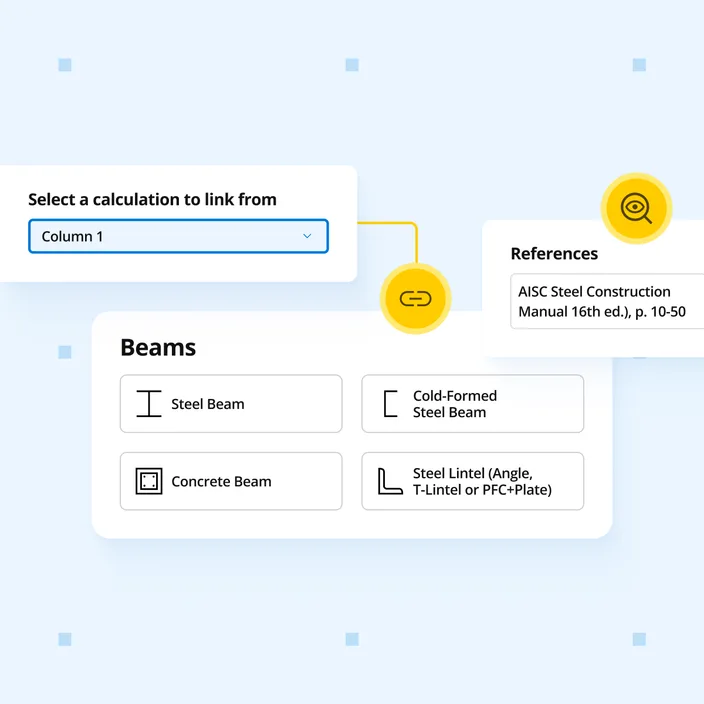
Design rectangular concrete columns to ACI 318-14 with customisable longitudinal bar layout. Checks include pure axial capacity, X- and Y-axis P-M interaction, biaxial bending via the Bresler method, and moment magnification for slender columns. Axial reactions from beams above link automatically.
Who uses this calculator
Axial load reactions from concrete beams above link directly to this calculation and update automatically. Design rectangular concrete columns to ACI 318-14 with customisable longitudinal bar layout; checks include pure axial capacity, X- and Y-axis P-M interaction, biaxial bending via the Bresler method, and moment magnification for slender columns.
How it calculates
The Rectangular Concrete Column (ACI 318-14) calculator designs columns in non-sway frames per ACI 318-14. LRFD load combinations determine the governing factored axial load Pu and biaxial moments Mu,x and Mu,y.
Interaction diagram
The P-M interaction diagram is generated from the ACI rectangular stress block with ultimate concrete strain εcu = 0.003. At each point on the diagram, the neutral axis depth c is varied from zero (pure tension) to infinity (pure compression), and equilibrium between the concrete stress block and the reinforcement forces gives the corresponding Pn-Mn pair.
The strength reduction factor φ transitions from 0.65 (compression-controlled, εt ≤ εy) to 0.90 (tension-controlled, εt ≥ 0.005) per ACI 318-14 Section 21.2. Failure mode (compression-controlled or tension-controlled) is reported for each axis check.
Slenderness (non-sway frame)
For slender columns (klu/r > 22 for non-sway), design moments are amplified via the ACI moment magnification method:
Mc = δs × Mu where δs = Cm / (1 - Pu / 0.75Pc)
Cm = 0.6 + 0.4 × (M1/M2) is derived from the user-entered end moment ratio. Pc is the Euler critical load based on the effective EI.
Biaxial bending (Bresler method)
For combined biaxial bending and compression, the Bresler reciprocal load method is applied:
1/φPn,biaxial = 1/φPnx + 1/φPny - 1/φPo
where φPnx and φPny are uniaxial capacities at the acting moment magnitudes about each axis, and φPo is the pure axial capacity. The biaxial utilization Pu / φPn,biaxial ≤ 1.0 must be satisfied for the column to pass.