What it calculates
Verifies open-web steel joist designations (K, LH, DLH, and KCS series) against SJI 100-2020 Load Tables under ASD load combinations. Checks bending and shear utilization at multiple positions along the span, deflection, and K-series end reaction limits. Seat reactions link automatically to downstream column, girder, and connection calculations.
Who uses this calculator
Joist seat reactions link directly to connected column and girder calculations - change span or loading and all downstream checks update automatically. Verifies K, LH, DLH, and KCS series joists against SJI 100-2020 Load Tables for distributed, point, and triangular loads, with bending and shear utilization at multiple positions along the span.
Size and analyse steel joists for distributed, point, and triangular loads, including LH-series.
How it calculates
SJI load table verification
The calculator selects the joist designation from the SJI 100-2020 library and retrieves the published total load and live load capacities for the specified span. The tabulated capacities assume uniformly distributed loading; for non-uniform loads (point loads or triangular distributions), the calculator converts the actual loading to an equivalent uniform load using SJI-specified methods before the table comparison.
For K-series joists, the critical check is the end reaction at the joist seat - the seat-weld capacity limits the maximum reaction regardless of span capacity. For KCS joists, only the uniform live load governs the selection; dead load does not factor into the table check for this series. The calculator flags the governing check (total load, live load, or end reaction) in the output.
Bending and shear check
Beyond the SJI table verification, the calculator evaluates bending and shear demand directly. The joist is modeled as a simply supported beam, and moment and shear envelopes are computed across all load combinations. Bending utilization at mid-span and shear utilization near the support are each reported as demand/capacity ratios.
For K-series joists, section properties (moment of inertia, shear area) are derived from the SJI standard section geometry for that designation. For LH and DLH series, the database includes the published geometric properties for each standard designation.
Deflection checks
Two deflection limits are checked for each span:
- Live load deflection: Typically L/360, configurable per span
- Total load deflection: Typically L/240, applied to the combined dead and live load case
Deflection is computed using the SJI published effective moment of inertia for each designation, which accounts for the truss-like stiffness of the open-web geometry. The calculator notes when bottom chord bridging is required per SJI 100-2020.
Applied load types
The calculator accepts three types of loading on the joist span:
- Uniform distributed load: Constant dead or live load per unit length, the most common configuration for floor and roof decks
- Concentrated point load: Single or multiple point loads, for mechanical equipment or structural transfers
- Triangular distributed load: Load varying linearly from zero at one end to maximum at the other, useful for sloped or trapezoidal tributary configurations
For any combination of these load types, the calculator resolves the resultant equivalent uniform load for the SJI table check and uses the actual distribution for the bending, shear, and deflection calculations.
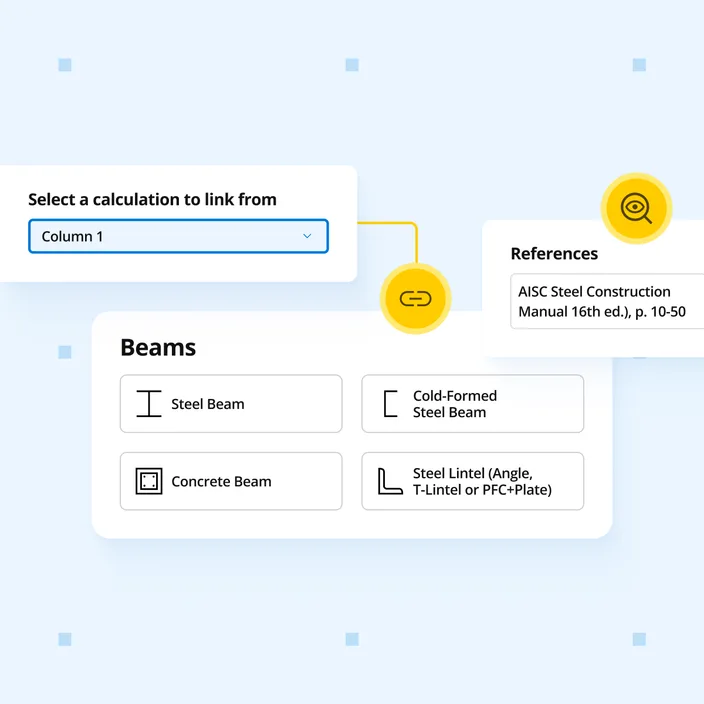
Seat reactions and load linking
Reactions at the left and right joist seats are reported separately by load case (dead, live, roof live). These reactions link as inputs to:
- Steel column calculations receiving tributary joist loads - the column factored demand updates when joist designation or loading changes
- Steel girder or beam calculations receiving multiple joists - the girder sees updated point loads at each joist bearing location
This load-path connection means a single change to joist loading propagates through the full framing system without re-entry at each step.