What it calculates
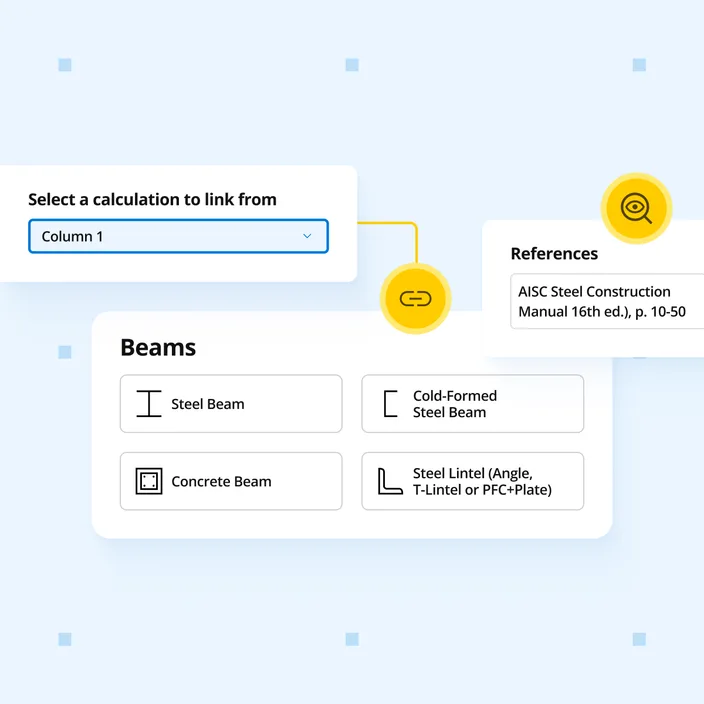
Beam reactions link to the columns and footings below, so load changes propagate downstream automatically. Design closed-section steel beams subject to torsion to AISC 360-16 ASD. Combined bending, shear, and torsion are checked per Chapter H alongside standard deflection limits.
Who uses this calculator
Beam reactions link to your column and footing calculations automatically - change a load once and everything downstream updates. For US structural engineers designing closed-section steel beams subject to torsional loading under AISC 360-16 ASD. Checks combined bending, shear, and torsion per Chapter H alongside standard deflection limits.
Check steel beams for torsion when shear loads are offset from the shear centre, combined with bending and shear in one template.
How it calculates
The Steel Beam With Torsion (ASD, AISC 360-16) calculator extends the standard ASD steel beam check with closed-section torsion provisions from AISC 360-16 Chapter H, covering combined bending, shear, and torsion on multi-span beams.
Section classification (AISC 360-16 B4)
Flanges and webs are classified as compact, noncompact, or slender per B4. For closed HSS sections, wall slenderness governs both local buckling classification and torsional section properties. The maximum slenderness ratio is checked against the limit and reported in the member properties panel.
Flexural capacity - AISC 360-16 Chapter F
Allowable bending moment Mn / Omega_b (Omega_b = 1.67) is calculated for positive and negative bending separately. For compact closed sections LTB typically does not govern, but the calculator evaluates all applicable Chapter F limit states including yielding, FLB, and LTB. utilization = M_service / (Mn / 1.67) ≤ 1.0.
Shear capacity - AISC 360-16 Chapter G
Allowable shear uses web shear coefficient Cv1: utilization = V_service / (0.6 Fy Aw Cv1 / 1.67) ≤ 1.0.
Closed section torsion checks - AISC 360-16 Chapter H
For closed sections the torsional shear stress is computed from the applied torque using the closed-form St. Venant torsion formula. The combined interaction of torsion, shear, and flexure is checked per Chapter H Section H3:
utilization = (Combined torsion, shear, and flexure force) / (Allowable combined strength) ≤ 1.0
The allowable torsion strength is governed by yielding under combined shear stress from flexure and torsion. The summary reports the torsional load, allowable torsion strength, and the combined interaction ratio.
Load combination analysis
ASD service-level combinations (D; D+L; D+S; D+0.6W; etc.) are evaluated with FEA. The governing combination for moment and shear is identified. Torsional demands are applied alongside gravity loads.
Deflection checks
Three deflection criteria are tracked: instantaneous live-load deflection, long-term deflection (with creep), and simplified DL+(LL or SL) deflection. utilization = delta / delta_allow ≤ 1.0 for each.
Inputs summary
Key inputs: section (closed HSS), yield strength Fy, span lengths, support types, incline pitch, applied bending loads with tributary width, required torsional loads, and deflection limit criteria. The torsional load input accepts the applied torque magnitude and location along the span.
Outputs summary
Summary outputs: allowable bending moment and demand, allowable and actual shear, torsional load and allowable torsion strength, combined torsion-shear-flexure interaction ratio, maximum slenderness ratio, maximum vertical and horizontal reactions, and deflection ratios for all three criteria.