What it calculates
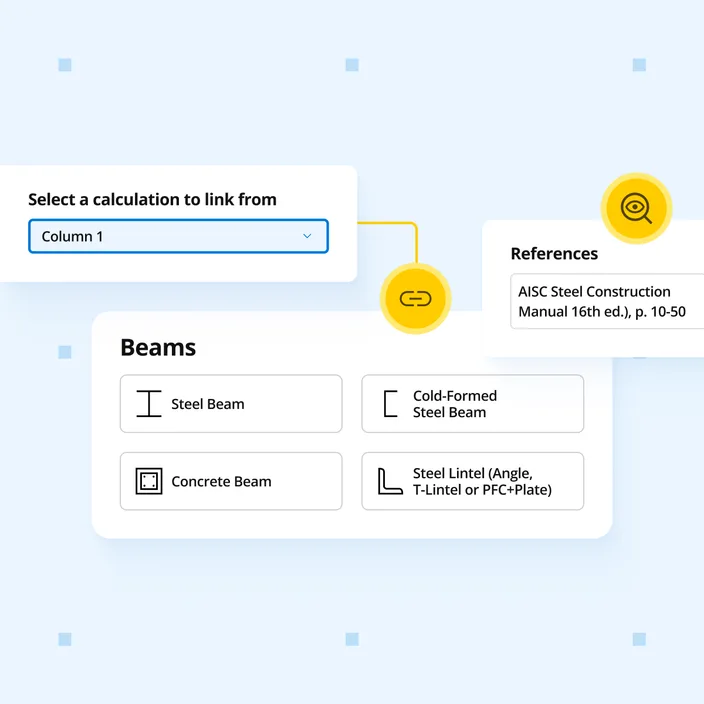
Design hot-rolled steel columns and posts to AISC 360-16 ASD using service-level loads. Checks cover allowable axial compressive strength, flexural and flexural-torsional buckling, and combined axial-plus-bending interaction. Column axial load links from beam reactions above and passes down to footing calculations below.
Who uses this calculator
Column axial load links from beam reactions above and links to footing calculations below - change a beam span and the footing design updates automatically. Structural engineers designing hot-rolled steel columns and posts to AISC 360-16 using Allowable Stress Design. For projects on the 2016 code cycle - use the AISC 360-22 ASD version for new work.
How it calculates
The Steel Column (ASD, AISC 360-16) calculator designs hot-rolled steel columns and posts using Allowable Stress Design. It runs a first-order structural analysis to determine service-level demands, then applies AISC 360-16 allowable capacity equations for all limit states.
Structural analysis
The calculator performs FEA on the column as a beam-column, resolving axial forces, moments, and deflections under service loads. End conditions (pinned, fixed, roller) are specified at each support. Concentrated axial loads and distributed lateral loads can be applied at any height along the column. A first-order moment amplification factor accounts for P-delta effects; the member is assumed to be part of a braced frame.
Axial compression capacity
Allowable axial compressive strength follows AISC 360-16 Chapter E:
utilization = Pa / (Pn / Omega_c) ≤ 1.0
where Omega_c = 1.67. The nominal strength Pn is governed by flexural buckling about the weak axis for standard doubly-symmetric shapes. For singly-symmetric and unsymmetric sections, flexural-torsional buckling is also evaluated. Slender element reduction factors (Q) are applied per Section E7 where local buckling limits the section capacity.
Flexural capacity
When moments are present from eccentricity or lateral loads, allowable flexural strength is checked per AISC 360-16 Chapter F:
utilization = |Ma| / (Mn / Omega_b) ≤ 1.0
where Omega_b = 1.67. Compact, non-compact, and slender section classifications per Table B4.1b govern the applicable strength equations. Lateral-torsional buckling is evaluated based on the unbraced length relative to Lp and Lr.
Combined axial compression and bending
The AISC H1-1 interaction check (ASD form) covers simultaneous axial and biaxial bending demands:
- For Pa / (Pn / Omega_c) ≥ 0.2: (Pa * Omega_c / Pn) + (8/9) * (Mxa * Omega_b / Mnx + Mya * Omega_b / Mny) ≤ 1.0
- For Pa / (Pn / Omega_c) < 0.2: (Pa * Omega_c / 2Pn) + (Mxa * Omega_b / Mnx + Mya * Omega_b / Mny) ≤ 1.0
Both strong- and weak-axis moments are included, covering the full biaxial bending case.
Axial deformation
Axial shortening under service loads is calculated and reported for serviceability review where column shortening matters to the structural system.
Outputs
The governing check and critical load case are summarised for easy QA and report documentation.