What it calculates
Design hot-rolled steel columns and posts to AISC 360-22 LRFD - the current edition required for 2024 IBC projects. Checks cover axial section capacity, flexural and flexural-torsional buckling, and combined axial-plus-bending interaction. Column loads link from beams above to footings below so changes propagate automatically.
Who uses this calculator
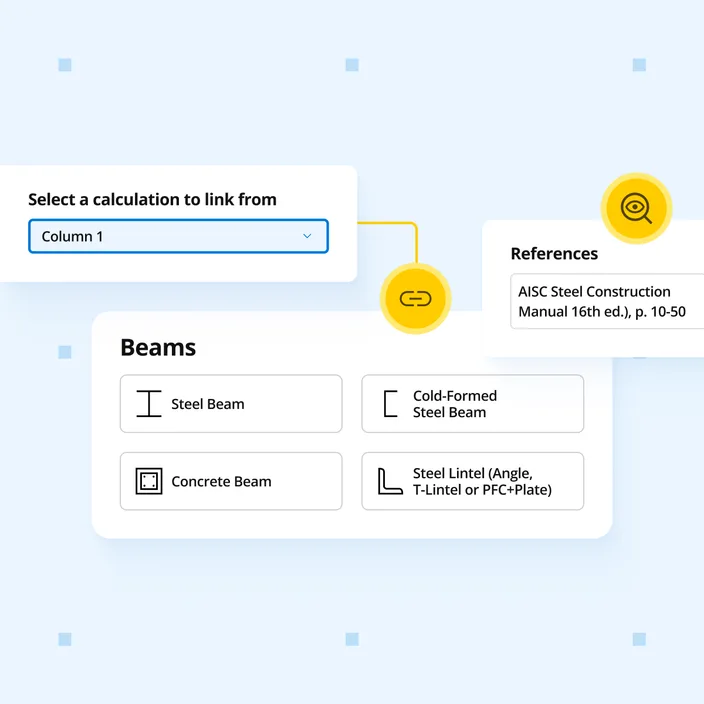
Column axial load links from beam reactions above and links to footing calculations below - change a beam span and the footing design updates automatically. Structural engineers designing hot-rolled steel columns and posts to the current AISC 360-22 LRFD under the IBC. Covers axial compression capacity, flexural and flexural-torsional buckling, and combined axial-plus-bending interaction for W-shapes, HSS, pipes, and custom sections.
How it calculates
The Steel Column (LRFD, AISC 360-22) calculator designs hot-rolled steel columns and posts using the latest edition of the AISC Specification. It runs a first-order structural analysis to determine demands, then applies AISC 360-22 capacity equations for all relevant limit states.
Structural analysis
The calculator performs FEA on the column as a beam-column, resolving axial forces, moments, and deflections under applied loads. End conditions (pinned, fixed, roller) are specified at each support. Concentrated axial and distributed lateral loads can be applied at any height. A first-order moment amplification factor accounts for P-delta effects, consistent with the assumption that the member is part of a braced frame.
Axial compression capacity
Nominal compressive strength follows AISC 360-22 Chapter E:
utilization = Pu / (phi_c * Pn) ≤ 1.0
where phi_c = 0.90. Fcr is determined from the slenderness-based equations using the governing KL/r ratio. For doubly-symmetric shapes flexural buckling about the weak axis controls. For singly-symmetric and unsymmetric shapes, flexural-torsional buckling is additionally evaluated. Slender element reduction (Q factors) is applied per Section E7 where local buckling reduces the member's available strength.
Flexural capacity
Moment demands from eccentricity or lateral loads are checked per AISC 360-22 Chapter F:
utilization = |Mu| / (phi_b * Mn) ≤ 1.0
where phi_b = 0.90. Compact, non-compact, and slender section classifications per Table B4.1b govern the applicable strength equations. Lateral-torsional buckling is evaluated based on the unbraced length relative to Lp and Lr.
Combined axial compression and bending
The AISC H1-1 interaction check covers simultaneous axial and biaxial bending demands:
- For Pu / phi_c Pn ≥ 0.2: (Pu / phi_c Pn) + (8/9) * (Mux / phi_b Mnx + Muy / phi_b Mny) ≤ 1.0
- For Pu / phi_c Pn < 0.2: (Pu / 2 phi_c Pn) + (Mux / phi_b Mnx + Muy / phi_b Mny) ≤ 1.0
Axial deformation
Axial shortening under factored loads is calculated and reported alongside strength checks for serviceability review.
Outputs
The governing check, critical load combination, and section properties are summarised for straightforward QA.