
Wood Beam (ASD, NDS 2018)

NDS 2024NDS 2018Flag of United States

Design and verify wood beams to NDS 2018 ASD - bending, shear, bearing, and three deflection limits, each shown with the governing NDS adjustment factors and code reference. Load reactions at each support link to connected column and footing calculations by load type, so a change to the beam updates them. Supports simple and continuous spans, multi-ply beams, flitch plate composite beams, and inclined configurations.

14-day free trial • No credit card required

  • NDS 2018 (ASD)

    Named standard on every check

  • Clause on every result

    Formula, inputs and reference visible

  • Updated 21 Aug 2026

    Version 208, latest calculation change

  • 51,000+ calculations

    In 2026 across 730 organizations

Inside the Wood Beam (ASD, NDS 2018) calculator

See what you set up and what Calcs.com checks, before you run your first calculation.

  • Flitch beams and engineered wood

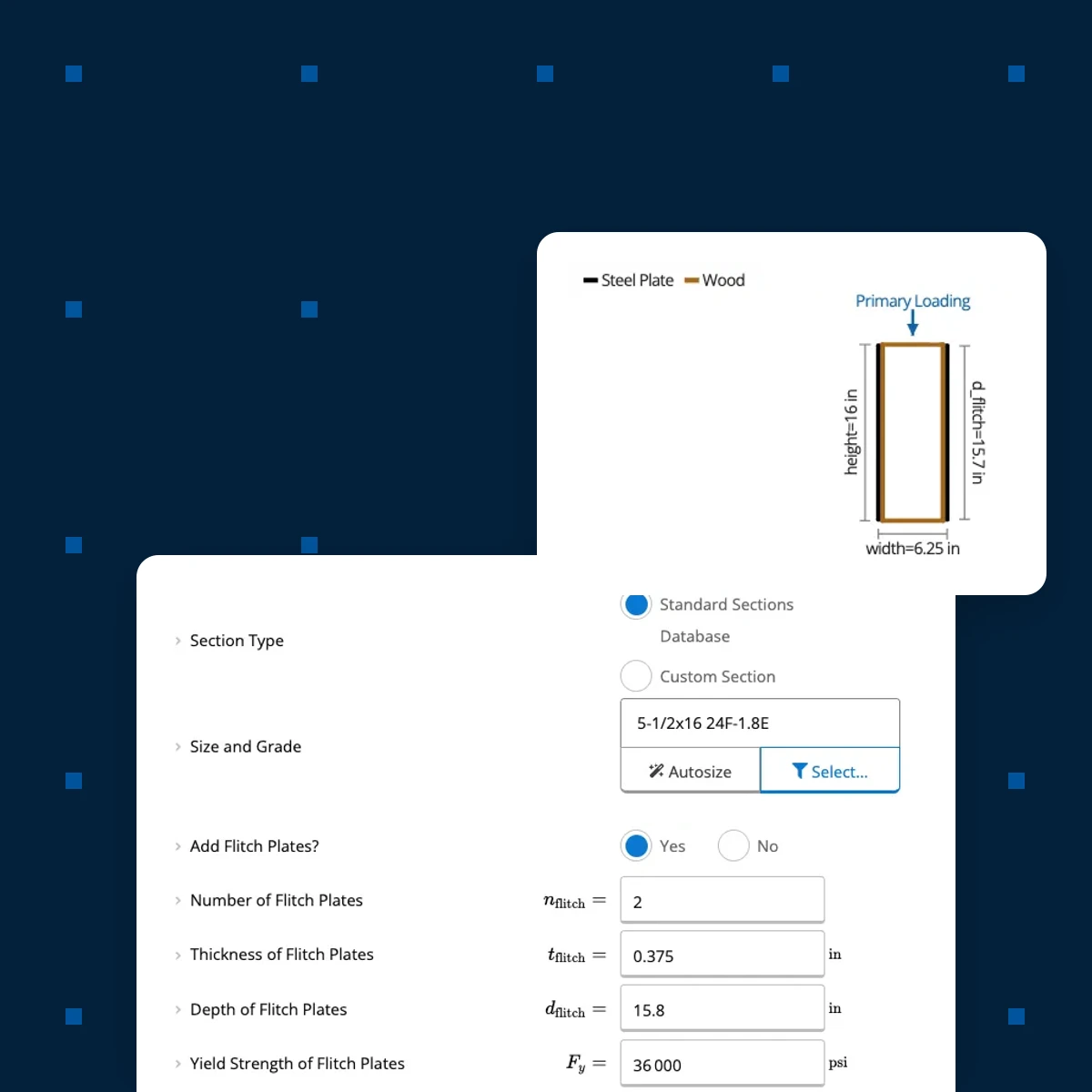
    Model flitch beams of timber and steel plates, or pick dimensional lumber, LVL, glulam or I-joists from the built-in database.

    Flitch beams and engineered wood in Calcs.com - a 5-1/2x16 24F-1.8E glulam with two 0.375 in steel flitch plates, 15.8 in deep, Fy 36,000 psi
  • Area, line, point and moment loads

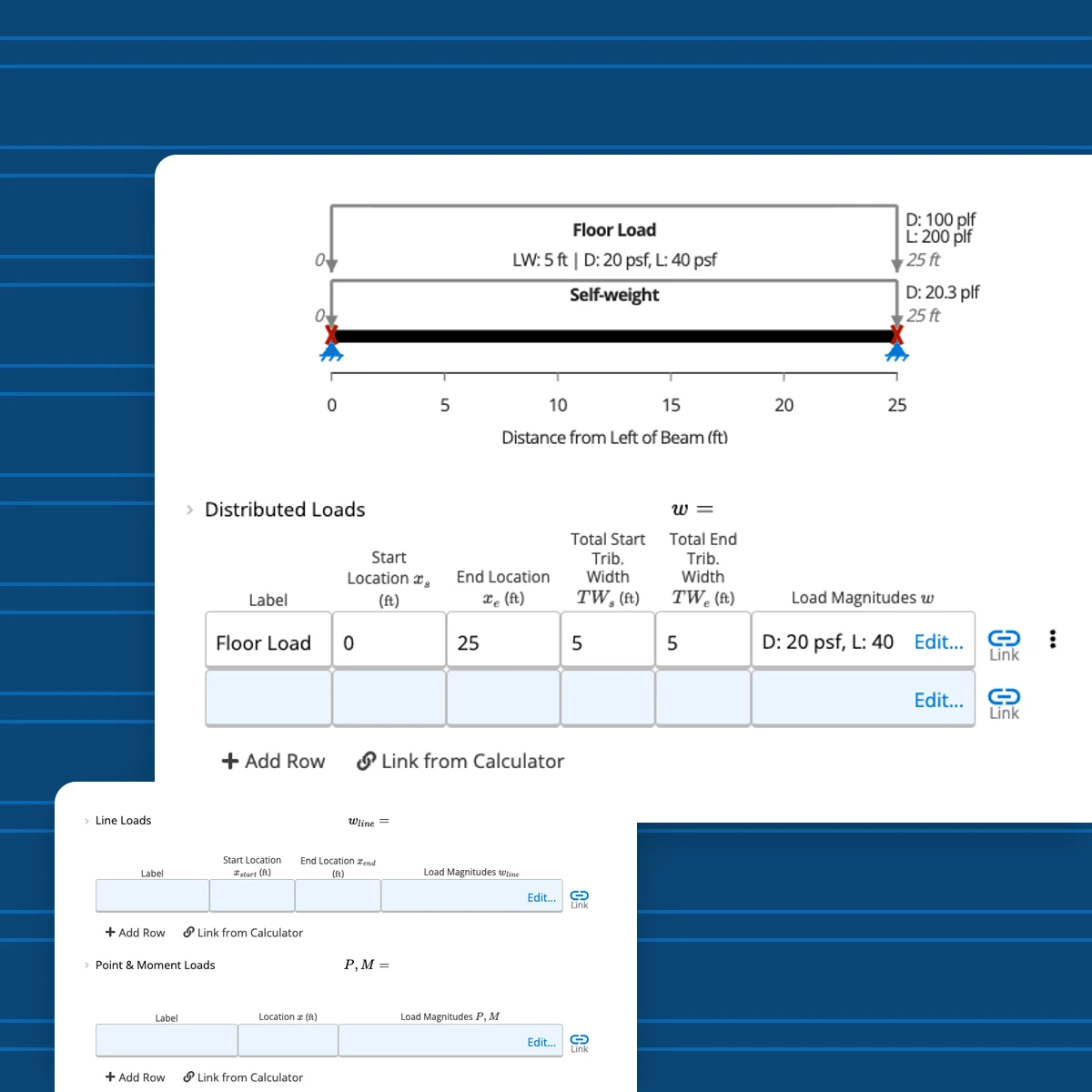
    Apply area loads over a tributary width, line loads, and point and moment loads, each by load type. Self-weight is added for you.

    Area, line, point and moment loads in Calcs.com - a 20 psf dead and 40 psf live floor load over a 5 ft tributary width with self-weight on a 25 ft beam, above the distributed, line, point and moment load tables
  • Bracing, wet service and bearing

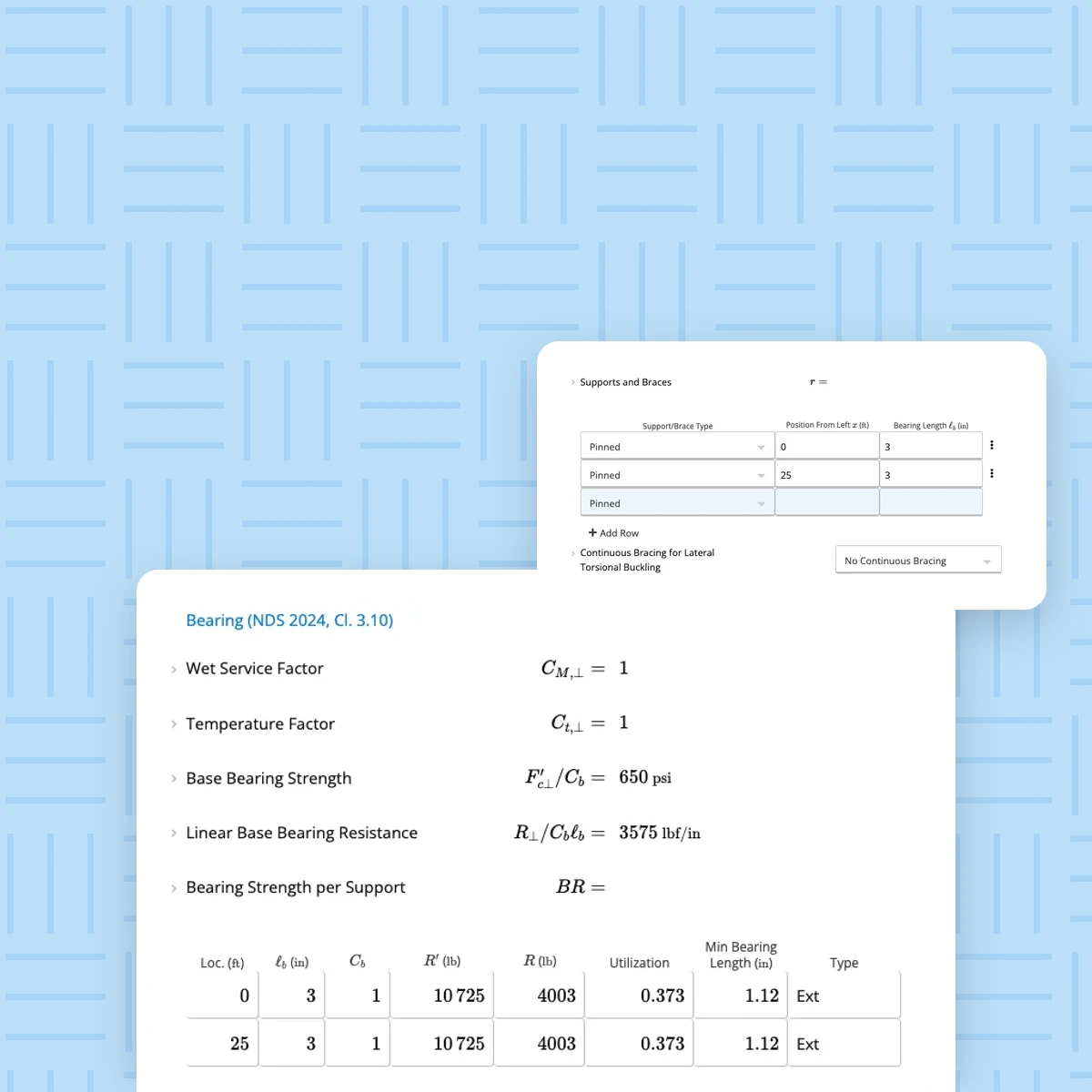
    Set lateral bracing, wet service and bearing conditions to match the project, applied per NDS Sections 2.3, 3.4 and 3.10.

    Bracing, wet service and bearing in Calcs.com - the bearing check with wet service and temperature factors and bearing at each support, above the supports and continuous bracing inputs
  • Shear, moment and deflection diagrams

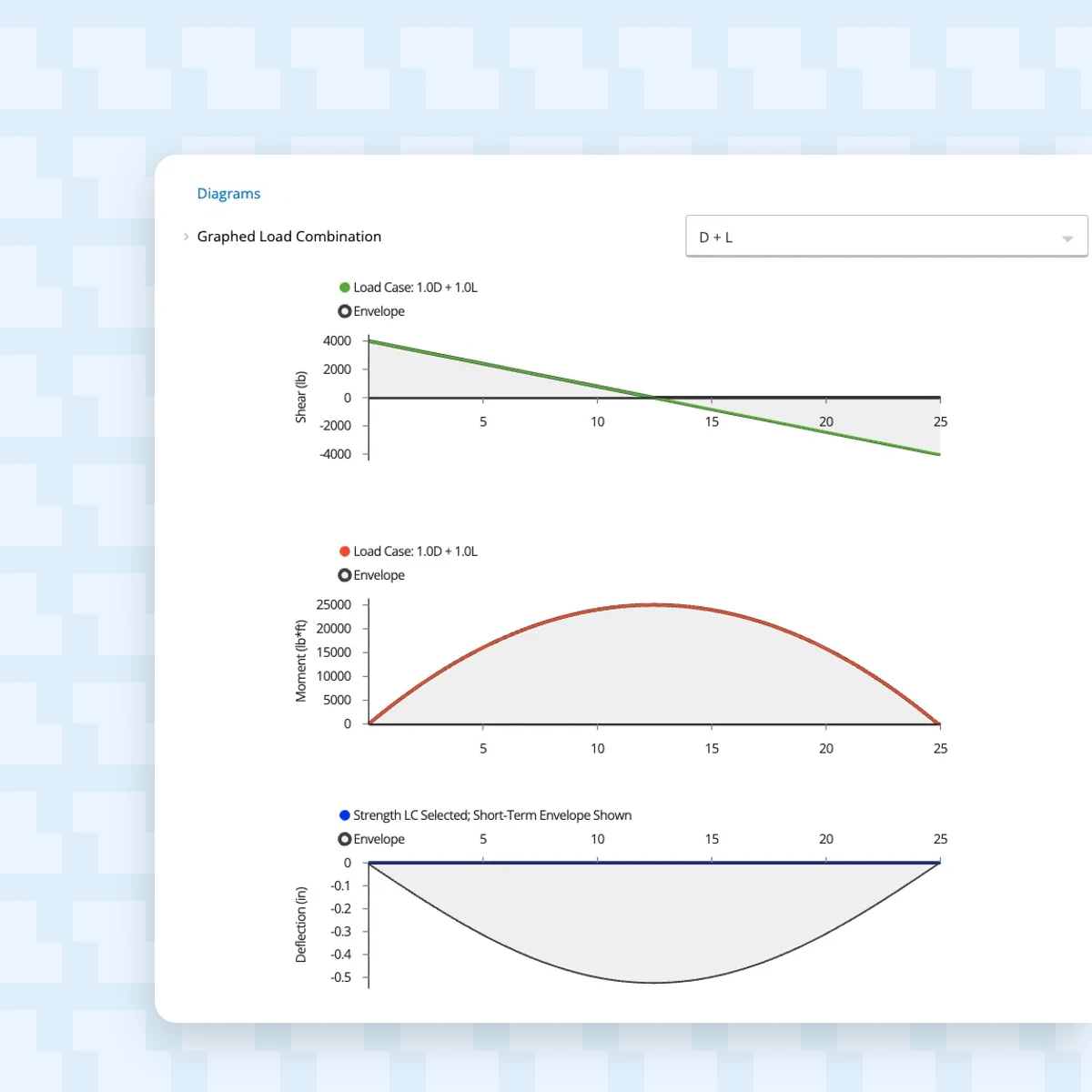
    Shear, moment and deflection diagrams update as you edit, with each design check marked pass or fail.

    Shear, moment and deflection diagrams in Calcs.com - a 25 ft wood beam under 1.0D + 1.0L, with shear, moment and deflection plotted along the span

Start from a preset

Pick the member closest to yours. Choose it when the calculator opens and its values load in.

What it calculates

Design and verify wood beams to NDS 2018 ASD - bending, shear, bearing, and three deflection limits, each shown with the governing NDS adjustment factors and code reference. Load reactions at each support link to connected column and footing calculations by load type, so a change to the beam updates them. Supports simple and continuous spans, multi-ply beams, flitch plate composite beams, and inclined configurations.

Who uses this calculator

Beam reactions link to your column and footing calculations by load type. Change a load once and the linked calculations update. All six NDS 2018 checks shown with code references: bending, shear, bearing, and three deflection limits. Includes multi-ply and flitch plate beams.

How it calculates

The Wood Beam (ASD) calculator checks sawn lumber, glulam, LVL, PSL, LSL and I-joist beams to NDS 2018 Allowable Stress Design. Beams can be single or multi-ply, with optional steel flitch plates. Each check divides demand by adjusted capacity, and the beam passes when every ratio is 1.0 or less.

Six checks

You get six utilization ratios, each from its governing load combination:

  • Bending: M / M'
  • Shear: V / V'
  • Bearing: R / R' at the most critical support
  • Short-term deflection: under L + Lr, S or 0.42W
  • Long-term deflection: under kD + L + Lr, where k adds creep to the dead load (0.5 dry, 1.0 wet)
  • Dead plus live or snow: D + (L or S), which you can switch off

Each deflection limit is a span ratio (L/n) capped by an absolute limit you set. Cantilever limits can be doubled.

Adjusted bending stress

F'b is the reference value Fb multiplied by the factors that apply to the product you pick:

  • Sawn lumber: F'b = Fb × CD × CM × Ct × CL × CF × Cfu × Ci × Cr
  • Glulam, strong axis: F'b = Fb × CD × CM × Ct × Cfu × the lesser of CL and CV
  • Glulam, weak axis: F'b = Fb × CD × CM × Ct × Cfu
  • LVL, PSL and LSL: Fb × CD × CM × Ct × Cr, with beam stability (CL) and volume (CV) factors
  • I-joists: the manufacturer's moment capacity, adjusted by CD, CM, Ct, CL and Cr

Moment capacity is M' = F'b × S, where S is the section modulus of all plies. Reference values come from the built-in species and grade database. LVL, PSL, LSL and I-joists use manufacturer data.

Load duration and service conditions

  • CD is set per load combination by its shortest-duration load, from 0.9 for dead load alone to 1.6 for wind and seismic.
  • CM applies in wet service, above 19% moisture content (16% for glulam).
  • Ct reduces capacity above 100°F, in two bands up to 150°F.
  • Ci applies to incised dimension lumber.
  • Cr adds 15% for repetitive sawn lumber members and 4% for LVL, PSL and LSL.

Beam stability

CL comes from the critical buckling moment of each unbraced segment, using the AWC TR14 method. The moment factor is taken conservatively as 1.72, or 1.0 for cantilevers. You choose continuous bracing on the top face, the bottom face, both or neither. Bracing both faces removes lateral-torsional buckling, so CL = 1.0.

Shear and bearing

Shear capacity is V' = (2/3) × F'v × A. Demand is taken at the highest point along the span, not at distance d from the support, which is conservative.

Bearing is checked at every support from the bearing length you enter. Short bearings get the bearing area factor Cb. Bearing under point loads is not checked.

Flitch plate and multi-ply beams

  • Bending uses the transformed timber and steel section.
  • Deflection uses the combined stiffness of timber and steel.
  • Shear and bearing are assigned to the timber.
  • Multi-ply beams bending about the weak axis act non-compositely.

Assumptions

The calculator states its assumptions on every sheet. The ones that most often matter:

  • Axial load is negligible. Check this yourself for inclined beams.
  • Members are straight, prismatic and not notched.
  • Glulam has at least four laminations.
  • I-joists are fully braced, with all holes within manufacturer limits.
Tested against worked examples

Each case shown is a worked example the calculator has been tested and verified against.

Red-I45 bending under snow load

RedBuilt Red-I45 I-joist design data

Manufacturer data

Red-I90 bearing and deflection

RedBuilt Red-I90 I-joist design data

Manufacturer data

Example 5.2

Timber Design for the Civil and Structural PE Exams, 7th edition

Textbook

What engineers say

Engineer

“Calcs.com simplified my beam analysis. It made structural checks easy and impressively fast. I first heard about Calcs.com while looking for alternatives to StruCalc, checked out a few options, and went with Calcs.com for simple residential beam analysis. The reports are strong, especially the one-page summary. I've also gotten used to linking beams within a project, which is handy for changing load scenarios and having that flow through other members. Over the years, Calcs.com has been responsive to feedback and requests, and the product continues to help me work through structural analysis faster than anything else I've used.”

Aaron D. Obermiller, P.E.

Engineer, REO Engineering

Engineer

“The wood and steel beam calculators are delightful. I especially like selecting the wood species for my beam and Calcs.com automatically loading all of the relevant material properties so I don't need to look them up in the NDS.”

John Cagle

Project Engineer, CHM Engineering

Frequently asked questions

Access this calculator and 100+ more

All verified, standards-aligned. Start a free trial - no credit card required.

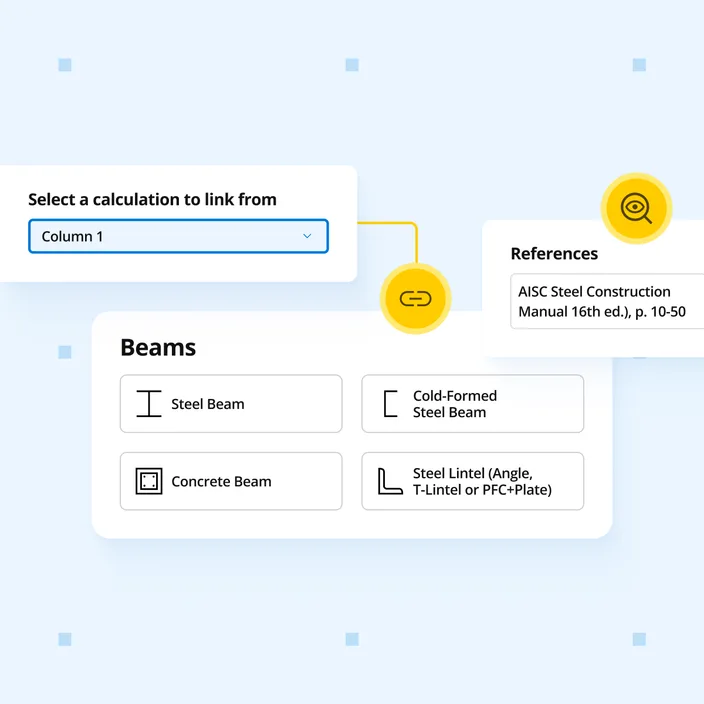
Linking a calculation to a column in Calcs.com, with the AISC Steel Construction Manual reference attached

We use analytics cookies to understand how you use this site and improve our content. See our privacy policy and cookie policy for details.