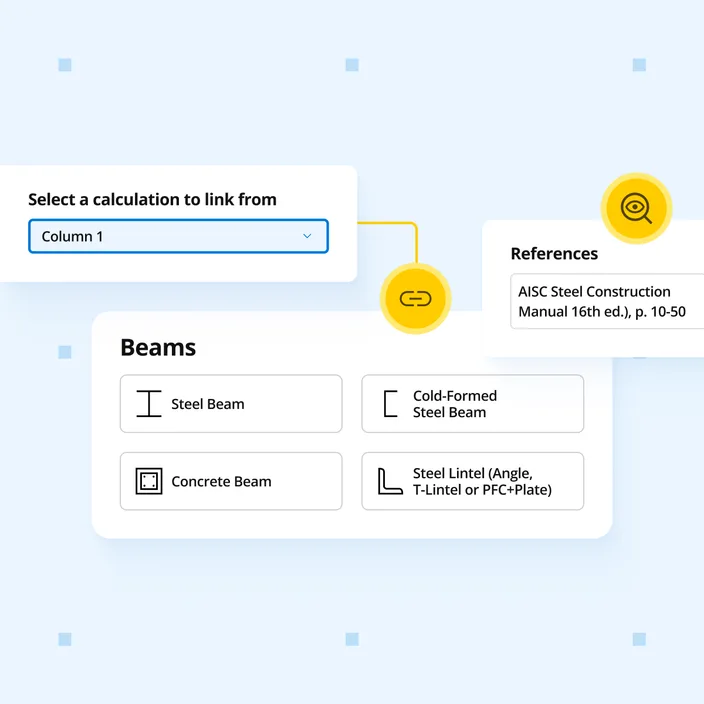
Calcs.com now covers NBCC 2020 and NBCC 2025 loads for structural engineers in Canada: wind on the main structure and on cladding, roof snow, and seismic base shear. Each code edition has its own calculator, so you can design to whichever edition your jurisdiction has adopted without mixing climatic data between them.
All seven calculators are in beta while they complete our quality assurance process. Use them to explore and check designs, not for production jobs, until the beta label comes off.
Low-rise wind pressures for the main structure, to NBCC 2020 and 2025
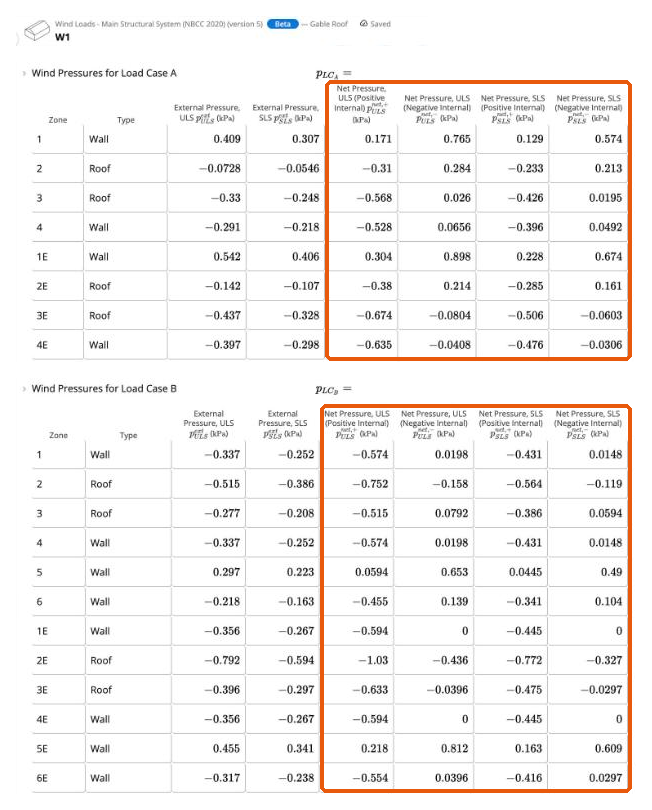
Under NBCC, main wind-force-resisting system (MWFRS) pressures need velocity pressure, exposure, gust and topographic factors, and internal pressure by opening condition. Then come the Table 4.1.7.6 coefficients for every zone, and only then Load Case A and Load Case B. NBCC 2025 moved the reference velocity pressure to a 1-in-500 basis. Carry over a value from 2020 climatic data and factored results are off by roughly 50%.
The new Wind Loads, Main Structural System (NBCC 2020) and NBCC 2025 calculators run the full static procedure in one sheet.
Region and standards: Canada, NBCC 2020 and NBCC 2025. Plan: Included in the Pro plan and every plan above it.
What's new:
- Low-rise buildings with flat or gable roofs up to 45°, with checks on the applicability limits (mean roof height up to 20 m and less than the least plan dimension)
- Zone-by-zone specified pressures for Load Case A and Load Case B, at ULS and SLS
- An optional hill and escarpment module that computes the topographic speed-up factor
- Reference velocity pressure and importance category pulled from project defaults, or overridden on the sheet
- In the 2025 edition: the 1-in-500 reference velocity pressure, the serviceability importance factor of 0.6, both internal pressure signs so the governing net envelope is explicit, and a check that the project is set to NBCC 2025
Watch the NBCC 2020 walkthrough
Watch the NBCC 2025 walkthrough
Cladding pressures for walls, roofs, overhangs and parapets on one sheet
Components and cladding pressures under NBCC come from log-scale curves on three separate figures (4.1.7.6.-B, -C and -E). Each zone needs interpolating by tributary area, then combining external and internal pressures at both limit states. Overhang and parapet rules are spread across several clauses, and the internal pressure on parapet cladding is easy to miss.
The Wind Loads, Components and Cladding (NBCC 2020) and NBCC 2025 calculators build those curves in, so every element type sits on one sheet.
Region and standards: Canada, NBCC 2020 and NBCC 2025. Plan: Included in the Pro plan and every plan above it.
What's new:
- Wall interior and end zones, and roof interior, edge and corner zones for flat and gable roofs up to 45°, interpolated on each member's tributary area
- Roof overhangs: net uplift with both surfaces included and no internal pressure
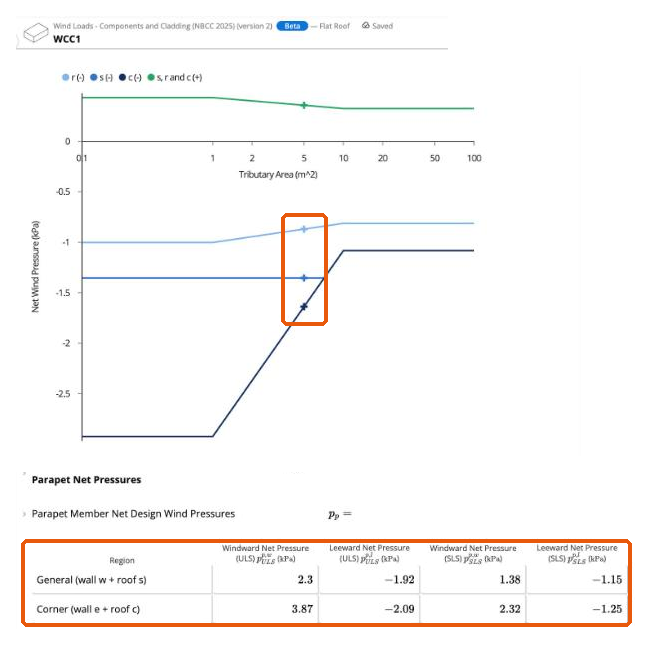
- Parapets: member net pressures for the windward and leeward cases per Cl. 4.1.7.5.(7) to (9), plus per-face cladding pressures with the -0.70 to +0.70 internal pressure coefficient of Cl. 4.1.7.7.(2)
- ULS and SLS net pressures per zone, with pressure-versus-area charts that show each member's design point
- In the 2025 edition: the 1-in-500 reference velocity pressure and the serviceability importance factor of 0.6. Canadian project defaults now offer the reference velocity pressure field that matches the project's edition, so a 1-in-50 value cannot flow into a 2025 design
Both editions were checked against the same hand-calculated cases. ULS pressures match exactly, and SLS pressures scale by 0.8, as the code change dictates.
Watch the NBCC 2020 walkthrough
Watch the NBCC 2025 walkthrough
Roof snow, rain and drift loads to NBCC 2025
NBCC 2025 reworked how roof snow loads are derived. Ground snow now comes from a 1-in-1000 annual probability basis instead of 1-in-50. A new thermal factor (CT) accounts for how the roof holds heat, and drift calculations use a winter wind factor (Fws). A 2020 spreadsheet doesn't carry over, and a building with several roof steps, parapets and projections needs a drift for each one.
The new Snow Loads (NBCC 2025) calculator implements Subsection 4.1.6 of the new edition in one sheet.
Region and standards: Canada, NBCC 2025. Plan: Included in the Pro plan and every plan above it.
What's new:
- Design roof load
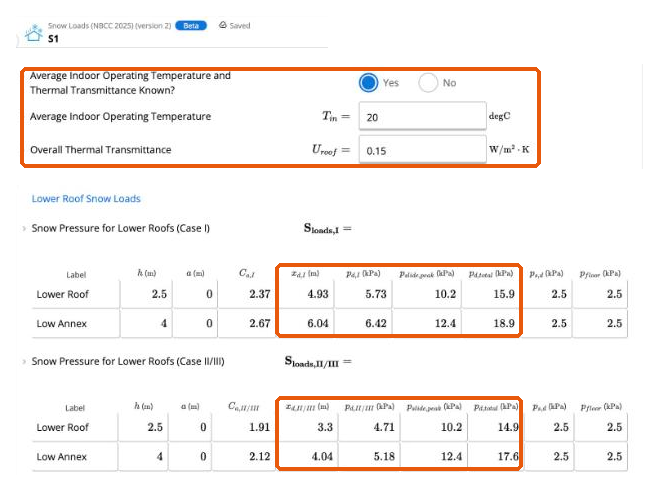
S = Is[Ss(Cb·Cw·Cs·Ca·CT) + Sr], with CT derived from winter average temperature, indoor operating temperature and overall thermal transmittance where known - Balanced, unbalanced gable (with an applicability check) and partial loading, plus the SLS snow load
- Drift on lower roofs for Case I and Case II/III using Fws, with table inputs so multiple roof steps, projections and parapets are checked in one sheet
- Sliding snow from upper roofs, combined with drift where both act
- Valley loads for Case I, II and III, with the governing peak reported
- Rain load Sr included in every case per Cl. 4.1.6.2, capped at Ss(Cb·Cw·Cs·Ca)
Seismic base shear and storey forces to NBCC 2020 and 2025
Seismic demand under NBCC 2020 and 2025 starts from site spectral values at six periods. Irregularities and system restrictions then decide whether the Equivalent Static Force Procedure is permitted at all. By hand, that means chaining hazard lookups, interpolation, applicability checks and base shear limits across several clauses, usually in a one-off spreadsheet.
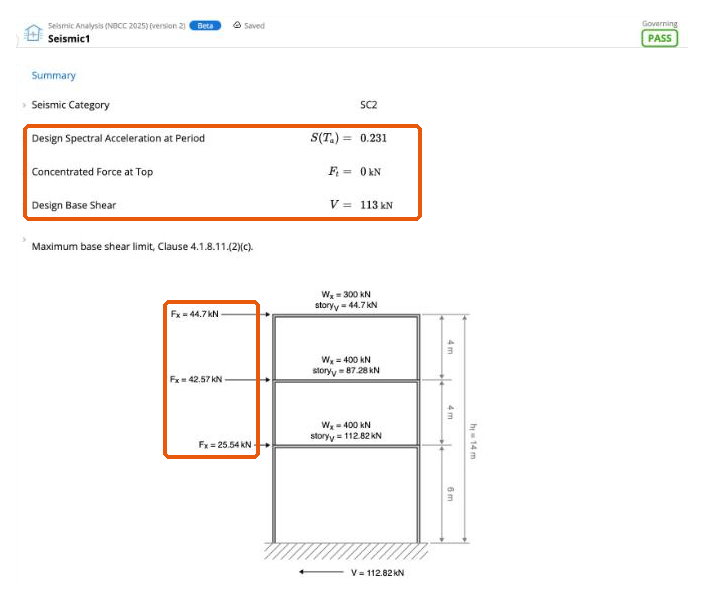
The new Seismic Analysis (NBCC 2020) and NBCC 2025 calculators take the hazard inputs straight through to base shear and storey forces.
Region and standards: Canada, NBCC 2020 and NBCC 2025. Plan: Included in the Pro plan and every plan above it.
What's new:
- Inputs for the six spectral accelerations Sa(0.2) to Sa(10.0), Vs30, storey heights and seismic weights, importance category, and the seismic force-resisting system (or custom Rd and Ro values)
- Fundamental period, design spectral acceleration S(Ta), and design base shear with the higher mode factor, checked against the code minimum and maximum limits
- Vertical force distribution including the top-storey concentrated force Ft
- Irregularity screening per Table 4.1.8.6 and the ESFP and system restrictions, with an explanatory note when a dynamic analysis is required
- A check on whether Art. 4.1.8.23 applies. In the 2020 edition, the sheet then adds the elastic analysis automatically
- In the 2020 edition, storey forces link into diaphragm and member sheets
Watch the NBCC 2020 walkthrough
Watch the NBCC 2025 walkthrough
If you design in Canada, tell us which NBCC calculator you'd like next.
Put your calculations in an environment that holds up under review
Calcs.com shows the standard edition, clause reference, and applied formula at every check, so a reviewer can evaluate the work without reconstructing it.
Start a 14-day free trial